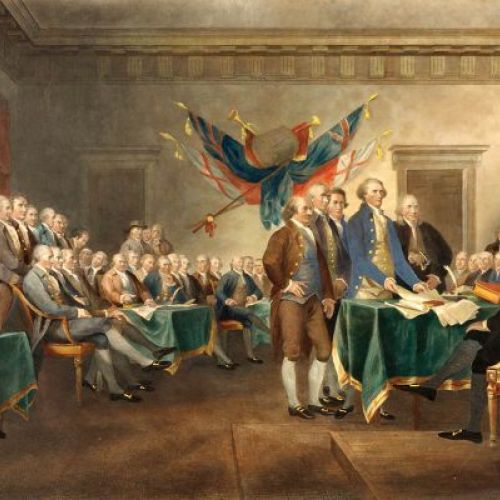
The “Committee of Five” (nearest the desk) present the first draft of the Declaration of Independence to the Second Continental Congress on June 28, 1776. It was officially adopted on July 4, 1776.
A key of signers of the Declaration of Independence.
Thomas Lynch Jr. (1749-1779), from what is now Georgetown
Thomas Heyward Jr. (1746-1809), from Jasper County
Arthur Middleton (1742-1787), from Charleston
Edward Rutledge (1749-1800), from Charleston
The Charleston Museum director Carl Borick near the “Becoming Americans: Charleston in the Revolution” permanent exhibit
By 1776, Charleston was the fourth largest city in British North America and the wealthiest due to the labors of enslaved West Africans on sprawling plantations across the Lowcountry.
The British Are Coming: A Revolutionary era map of Charlestown in 1780, including fortifications, Gadsden’s Wharf, and 10 vessels moored in the harbor, prior to city’s fall to the British
After fighting for the British in the French and Indian War, Charleston-born William Moultrie became a local leader in the patriot cause and designed the deep blue flag with a white crescent, the first American flag flown in South Carolina.
King George III and the English Parliament’s Stamp Act 1765 taxing written documents in the colonies
Tony Youmans, director of the Old Exchange and Provost Dungeon, which witnessed the blocking of British tea, the election of Continental Congress delegates, and South Carolina’s ratification of the US Constitution
King George III
Philadelphia’s William Bradford adds the “Fatal Stamp” to his newspaper.
September 5-October 26, 1774: Delegates from 12 of the 13 American colonies meet in Philadelphia as the first Continental Congress to discuss America’s future under growing British aggression.
Exchange Building Dungeon
May 8, 1775: The news of the April 19 Battle of Lexington and Concord—the first shots of the Revolution—reaches Charleston.
June 18, 1775: Royal Governor Lord William Campbell (left) arrives in Charleston and refuses to recognize the Provincial Congress. He will dissolve the General Assembly in September and escape Charleston aboard a British warship.
Built circa 1769, the Miles Brewton House served as British army headquarters for two years during the War for Independence.
The Old Exchange
Housed at the Old Exchange, a “wet ink” copy of the Declaration of Independence. It was read to townspeople there on August 5, 1776.
Once the home of Declaration signer Thomas Heyward Jr., the circa-1772 Heyward-Washington House is a house museum on Church Street.
The International African American Museum is located near the site of Gadsden’s Wharf on Charleston Harbor.
Fort Moultrie is the site of the Battle of Sullivan’s Island, an important victory for the patriots that took place on June 28, 1776.
A plaque on Alexander Street in Ansonborough marks a spot near the original Liberty Tree, where the Sons of Liberty met to advance the patriot cause
Flag of Fort Moultrie
November 1, 1775: South Carolina’s Provincial Congress’s second session convenes in Charleston. William Henry Drayton is elected president.
November 7, 1775: John Murray, the Fourth Earl of Dunmore and Royal Governor of Virginia, declares martial law in Virginia via The Dunmore Proclamation and offers freedom to enslaved people and indentured servants who would fight for the British against the American rebels.
John Murray, the Fourth Earl of Dunmore and Royal Governor of Virginia
This painting, Sir Peter Parker’s Attack Against Fort Moultrie (oil on canvas, 20 x 30 inches, 1782-1791), illustrates the British Navy’s foiled attempt during the Battle of Sullivan’s Island on June 28, 1776. The fort was named for General William Moultrie after the patriots’ victory.
Charleston 1776 (oil on board, 1974) by military artist H. Charles McBarron depicts Continental soldiers repelling the British Navy fleet during the Battle of Sullivan’s Island and Sergeant William Jasper raising the Moultrie flag after it was shot down.
November 11-12, 1775: The naval battle of Hog Island is fought in Charleston Harbor, the first military engagement of the Revolutionary War in South Carolina.
Gadsden Flag
Battle of Sullivan's Island
August 5, 1776: The Declaration is read in Charleston three times: at noon near the South Carolina Statehouse, at 1:30 p.m. in the Exchange building, and at 3 p.m. at the Liberty Tree.
Reenactors of the 2nd South Carolina Regiment performed a musket drill and firing demonstration at Fort Moultrie National Historic Park on Carolina Day 2021.
Get a refresher on the city’s integral role in preparation for our country’s 250th anniversary