Learn where you can find his work celebrating the country’s 250th anniversary
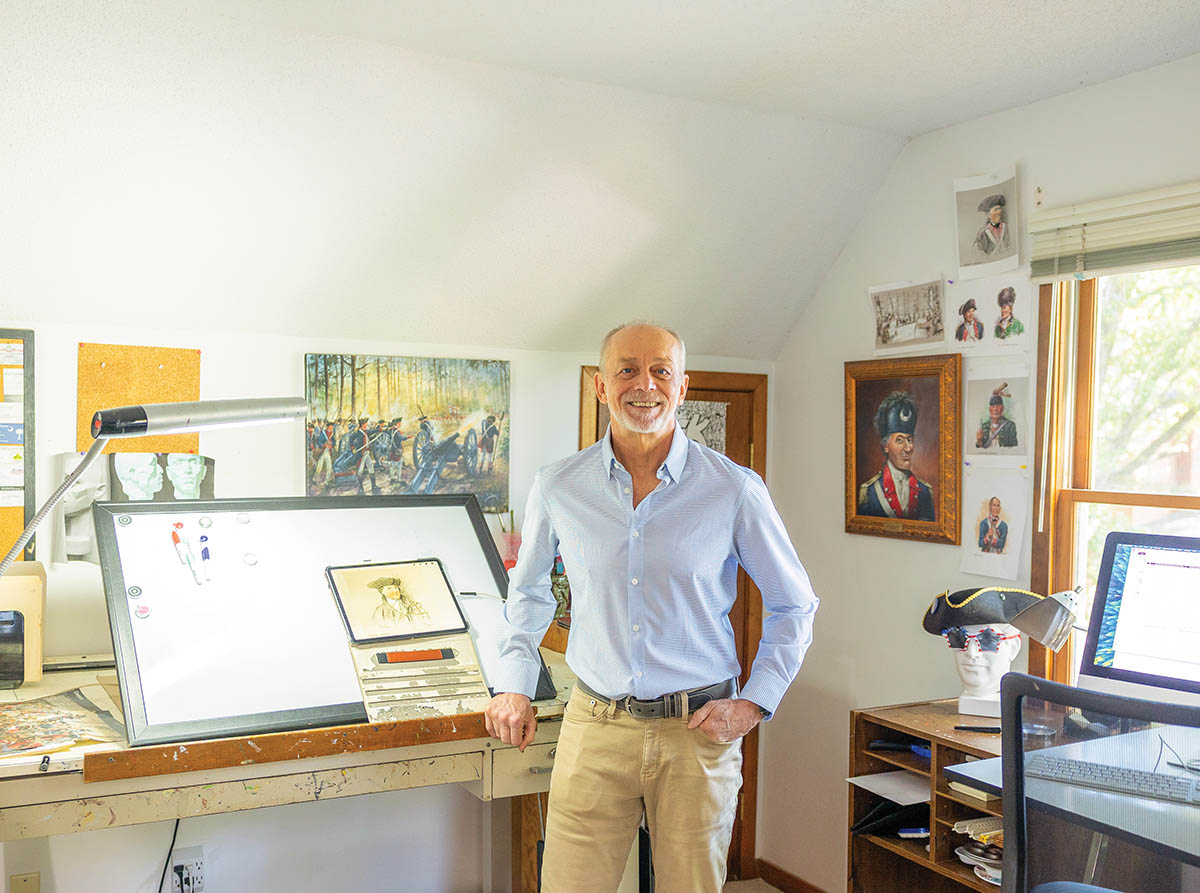


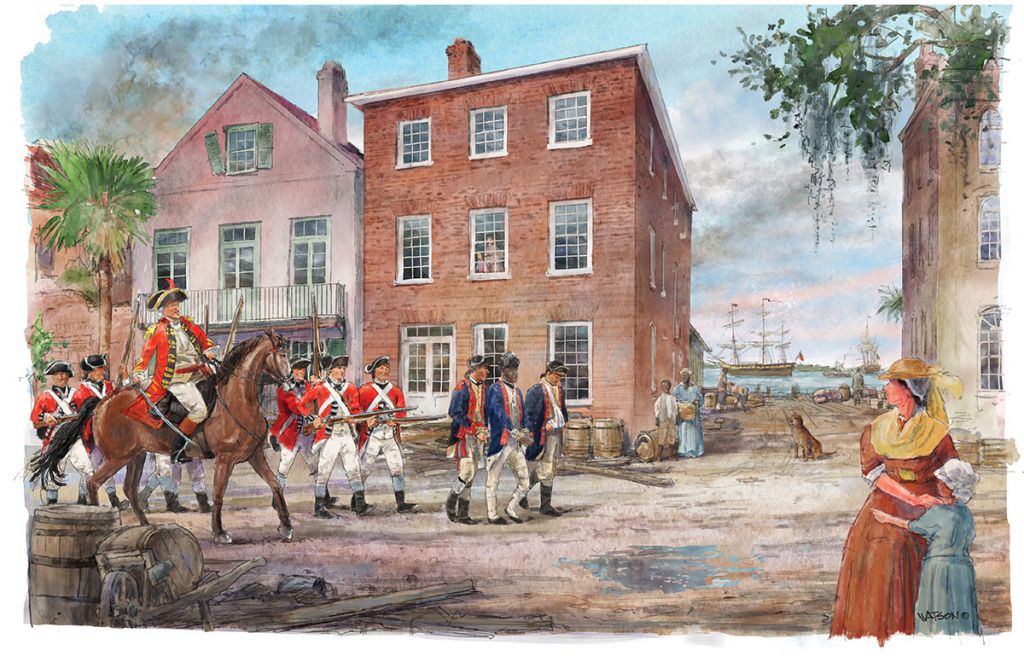

Dale Watson has spent decades turning historical moments into vivid, meticulously researched illustrations that reach audiences far beyond his hometown. The Mount Pleasant-based artist’s work brings the past to life at the Old Exchange Building and the Liberty Square Fort Sumter exhibit, as well as the American Revolution, a traveling exhibit produced in partnership with American Battlefield Trust and the Daughters of the American Revolution. His illustrations power the Liberty Trail app that guides users through Revolutionary War battle sites across South Carolina.
Most recently, his art, which uses traditional and digital media, caught the attention of legendary documentary filmmaker Ken Burns, who featured one of Watson’s pieces in his latest PBS series, The American Revolution. With Charleston serving as a host city for America’s 250 anniversary celebrations, Watson is having a milestone year. Here, he shares how his focus on illustrating historical events has evolved.
Becoming an Artist: As early as I can remember, I was drawing. My dad was a minister, and my mom would give me a pen and paper in church so I wouldn’t fidget. I drew the backs of people’s heads and anything else I could see. After a few years in the Army, I went to Trident Tech and then College of Charleston and later worked at an architectural firm. I thought I wanted to be an architect, but I started doing the renderings for the firm and found my calling. That’s really where my career began. I consider myself an illustrator rather than a fine artist. It’s about telling a story.
Historical Focus: It kind of happened organically. I did illustrations for The Charleston Museum, then got a request to do a mural for the National Park Service at the Liberty Square Fort Sumter exhibit. The Old Exchange noticed that work and asked me to do some paintings that would become murals there in 2017. As a result, a local historian named Doug Bostick reached out. He was president of the South Carolina Battleground Preservation Trust, and they had partnered with the American Battlefield Trust to create the Liberty Trail app. My illustrations are part of it, and you can walk around the actual sites while it tells you what happened. It just took off, and they kept me busy. That morphed into a lot of other historical work.
Showing Interest: I’ve always been a history buff, though I hadn’t done much historical work early on. When my parents passed away, we were cleaning out the house and found a cedar chest my mom had kept. It was full of drawings from before I even started school: Daniel Boone, soldiers, and pilgrims holding an American flag. I didn’t know she’d saved them. I think the interest was always there.
His Process: I work with historians based in South Carolina, Washington DC, and around the country. They usually give me a battle to depict. We brainstorm, they send whatever research they have, and I start with thumbnail sketches. Once we have a direction, I do a loose, rough sketch, then a line drawing, then I start adding color. There are always people scrutinizing the button colors, uniform styles, jacket lengths, and hats. It’s a little dance we do every time, trying to get as close as we can. It’s fun telling the story.
Celebrating America 250: I have an exhibit at the Old Exchange through the Fourth of July, as part of SC250 Charleston. After that, I move on to [an exhibit at] the Camden Archives and History Museum. I’m also working on a project called “Step Into History” at Princeton, where a filmmaker is creating a short video with a historian who literally steps into one of my illustrations of the Thomas Clarke House. I’m excited to go to my studio every morning. The way doors have opened, it’s been almost providential.