
When the Central America sank off the coast of the Carolinas, it took hundreds of lives and 30,000 pounds of gold with it
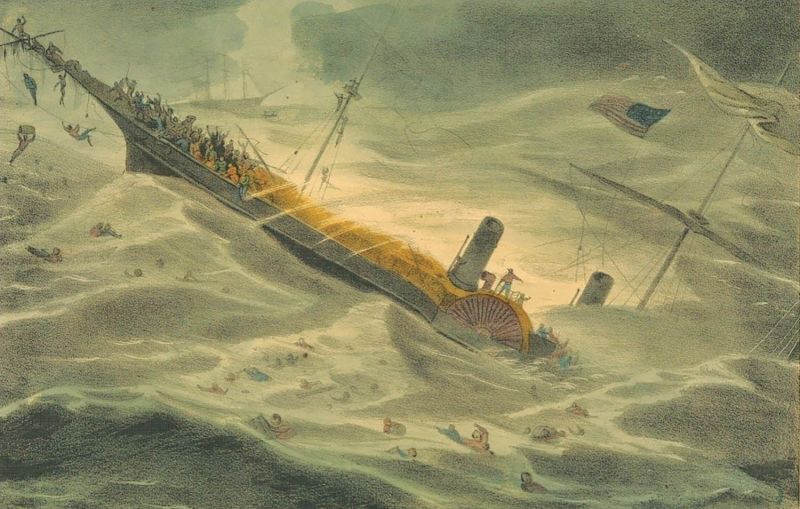


On September 17, 1857, a worried nation focused on the alarming news coming from Charleston: The USS steamship and mail boat Central America had been reported lost, along with its 477 passengers and 101 crew members, after battling a hurricane in the Atlantic. Perhaps not until the Titanic tragedy of 1912 would the public be as mesmerized by a similar loss at sea.
Most of the Central America’s passengers had boarded the ship Sonora in San Francisco on August 20, but instead of taking the long and perilous trip around the tip of South America, they disembarked at Panama City. Advances in technology had changed a weeklong trek through the jungle to a comfortable four-hour train ride to Aspinwall, on Panama’s east coast, where passengers, their luggage, and the ship’s 30,000 pounds of gold (perhaps one-fifth of the country’s reserves) were reloaded on the Central America. The US economy was in crisis, with runs on banks in New York. There was a vital need to get the gold into the banks’ vaults to back up deposits and prevent a national depression.
The Central America left on its northward journey on September 3 and ran into bad weather off the coast of the Carolinas on September 10. High seas breached the boilers, rendering the paddlewheel powerless and leaving the ship at the mercy of the waves. Men were ordered to bail; at least one woman, wanting to help, put on breeches to disguise and distinguish herself. By September 12, with doom approaching, men abandoned their money belts weighted with gold, and women were lowered into lifeboats. Then, the brig Marine of Boston came into view, rescuing 100 survivors.
A few hours later, the Central America went down, pulling hundreds who had jumped into the sea into the ship’s powerful suction. Miraculously, on the following day when the seas were more calm, the captain of the Norwegian ship Ellen, who was unaware of the disaster, changed his course and was able to save 50 more people. Three more survivors were found nearly a week later.
As the economy faltered at the loss of gold, reformers called for more safety precautions and the demand for a transcontinental railroad to prevent similar disasters grew. But the story did not end there. Years later, on September 11, 1989, a treasure-hunting crew set out to find the wreck, eventually retrieving more than $100 million of gold coins and bullion, including a 80-pound gold ingot that later sold for more than $8 million at auction.
Misfortune continued to shadow the Central America. The lead salvager was sued by insurance companies, went into hiding for years, and then was overwhelmed by a maelstrom of lawsuits from investors—ripple effects coming more than a century and half after the original tragedy.