The indoctrination of a Lowcountry voluptuary
Written By: Barbara G.S. Hagerty
I am a native of Charleston who first saw the light of day on Calhoun Street, at Roper Hospital, in the sultry month of September, at the height of hurricane season. This small accident of geography produced a giant imprint, for Charleston and the Lowcountry are as much a part of my DNA as my lazy eye and cowlick.
To have been born and raised among such rampant beauty—natural as well as man-made—is to be spoiled for life. It is to view the world through an aesthetic prism that has few comparables. It is to inherit a seat at a table set for a feast for the senses. And it is to be forever prejudiced, for after constant exposure to this rare symphony of dazzling light, ravishing color, and exquisite geometries, few places ever quite measure up to home.
Some think, and rightly so, that Charleston and the Lowcountry are a last bastion of civility and good manners. They are that, and more. Charleston contains all the contradictions of a dream: beneath our decorous surface is a sensualist’s domain. We are the garden of Eden after the fall. We are the lush jungle and the panther, conjured by the brush of Henri Rousseau. We are the beast and the beauty, the wild rose and the dilapidated tombstone, the old brick wall and its chink.
The indoctrination of a Lowcountry voluptuary begins in the nursery before the onset of speech or consciousness. It is olfactory, tactile, auditory, visual, and gustatory. My earliest memories catalog a baptism of the senses: the house on Water Street, an open window, the oscillations of the electric fan. Grits on the stove for supper along with sweet creek shrimp, followed by sugar cane for dessert. The tall sugar canes propped up in the kitchen and the machete for cutting them. The thrashing of palmetto fronds against the window panes in the breeze. The commingled scents of tea olive and pluff mud, jessamine and paper mill. The lyricism of voices, inflections. Mosquito netting. The fan’s drone and the mosquito’s vertigo.
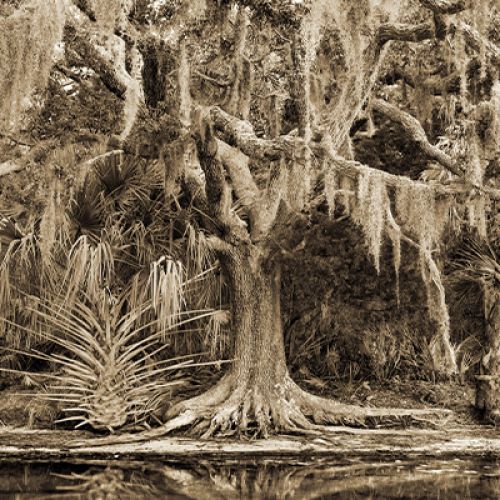
No wonder a Lowcountry birth confers upon one more than an address: it’s an identity forged from this matrix of rivers, marshes, maritime forest, and urban antiquity. Early on, a native absorbs the rhythm of long, hot days and witnesses the fantastic fertility of the place, where wild cabbage palmettos, scrub oaks, yucca, bay laurels, wax myrtles, mosses, prehistoric alligators, herons, terrapins, and cormorants still flourish. Here, wildness is still honored; wilderness still possible. Bobcats, horned toads, red-tailed hawks, sea oats, sand dunes, and fiddler crabs are the distinguished faculty in this seductive, sensory curriculum.
Though human-made, the antebellum city equally seduces, both with its sweeping panoramas and small vignettes. The old city’s roofline, quaint and fanciful, as though cut by a silhouettist’s scissors. The Battery sea wall and its views onto the harbor and old forts. Cargo ships and sailboat regattas. Languid tiger cats drowsing on slate sidewalks. Magical downspouts. A stone Buddha sitting under a marble urn full of red geraniums. Fluting Pans and naked cherubs in fountains. Hidden alleys, serpentine streets. The briny fragrance of the ocean. Music, wafting in the squares. The smell of peanuts, boiling all day in a heavy pot. Tropical rain pelting a tin roof. The faint swoosh of wing beats as a flock of ibis flies over the High Battery at dusk. The paint box of colors on stucco houses and the lacework of old wrought-iron gates and balconies.
The gustatory pleasure of a tomato grown on Edisto Island, an onion grown on Wadmalaw, a flounder caught in Sand Creek, an oyster pulled from its local bed. And the delicious place names that abound: Huger, Hasell, Legare, Prioleau, and Vanderhorst among the venerable old city streets; Pocataligo, Winyah, Toogoodoo, Jehossee, and Leadenwah marking the Lowcountry’s rural lands and rivers.
Whenever people from off ask me about why I live here, I always reply that it’s the proximity of culture to nature that makes this place so remarkable. A treasure trove of 18th- and 19th-century architecture and semitropical gardens flourish within what remains—and, thanks to an especially visionary local conservation ethic, much does remain—of a coastal jungle. The scent of a tidal creek, the slant of afternoon light on a piazza, the tang of salt air, a glimpse of a dolphin in the river or of ornate scrollwork on an old column: together they amount to a banquet for the senses. If this is ruination, it is both rare and sweet. Bring it on.
The true power of the humble snack food
Written By: Bessie Gantt
It’s not hard to be a good host in Charleston. You can simply get a box of Mrs. Hamby’s chicken salad sandwiches and a fifth of bourbon, and the party is on. Or maybe you’re one of those hosts who sets out the linen cocktail napkins and chafing dish at the first whiff of an upcoming christening or engagement. No matter your style, there is one party food—really a party in itself—that, despite its humble roots, rises above all others.
It’s salty, wet, and may leave a trickle running down your arm. You’d think it’d be considered gauche, yet well-mannered ladies have served it from sterling punch bowls. And these same ladies have slurped up its goodness with a familiarity that shows it’s by practice and not by accident that they manage to avoid a drop on their Sunday finest. It’s the boiled peanut, and it’s a powerful thing.
My grandfather made some of the best. They were supernaturally large with hard sinewy shells and opened with a satisfying fwump of the thumb. The fleshy nuggets sat ready to be plucked or sucked from their watery beds. My grandfather boiled them in big batches under his house, producing a mysterious cloud that smelled like dirt. Was this where the magic happened, or was it in the nuts themselves? If you asked him where he got the raw peanuts, he’d mumble, “Down at the crossroads,” and you’d nod like you knew where he meant.
If someone was sick, my grandfather sent a knotted plastic grocery bag full of goobers. If someone had a baby, the same. Graduation party, plastic bag. Six-hour car trip, plastic bag. Boat ride, funeral, tennis match: plastic bag, plastic bag, plastic bag. If at the moment you were inexplicably sated with peanuts, you could go ahead and stick the whole bundle in the freezer. When a need arose, such as welcoming a new neighbor, the peanuts miraculously plumped back to life after a hot bath on the stove top.
It’s not as simple as random acts of goobers—my grandfather knew what he was doing. He knew that no matter what your condition, your celebration, your ailment, or your journey, eating boiled peanuts makes you feel better. If you’re at a party and have poor social skills, head to the peanut bowl. Your nervous hands will find steady work in the shells, and with your mouth full, no one will expect you to talk. If pressed, you need only say, “Good peanuts, huh?” and keep on shelling. Just be sure there are plenty of goobers to go around; otherwise, you’ll be worse off than you were before. You’ll be known as the poor sap who ate all the peanuts, and people will say to you, “Good peanuts, huh?” even when you’re not eating them.
Or if you are brooding and enjoying it in a Pat Conroy kind of way, eating boiled peanuts can enhance the experience. Grab a cupful, dangle your legs over the side of a dock, chew each nut slowly, toss one half of the shell into the water, and watch as the current pulls it away from you. Then toss the other half. Repeat.
When you’re fishing and nothing is biting, you can pick out a target—a rotting post or a crab pot float, for example—and have a friendly competition with your buddy to see who can stick a shell to it. Or if you’re tailgating and your team is doing poorly, you can chomp the nuts with conviction and flick the shells onto the ground with the intensity with which you wish your team were playing. You can even grind the shells into the ground with your shoe if it makes you feel better, all the while savoring the salty, slithery taste that will brace you against any score.
The following mode of peanut therapy may be too advanced unless you are a seasoned gobbler. My grandfather mastered this technique. If you should find yourself on a porch, or in a kitchen, or on the beach with someone, and you’re not sure if she is mad at you, or if you have a crush on the person, or if you have something to say but you just don’t have the words for it, eat the goobers like you don’t give a damn and then toss a shell at her when she isn’t looking to see what she does. You’ll get your answer.
Ask my grandmother or anyone who knew my grandfather, and they will tell you communication was not his gift. But I just don’t believe that’s exactly true. The man made the best goobers around and shared them with almost everyone he met. Doesn’t that say something?
The host with the best goobers is bound to attract a crowd, and my grandfather usually did. I don’t think he minded if it was his boiled peanuts that brought people to his Citadel tailgates or Fourth of July parties. Serving the peanuts was his way of saying, “I’m glad you’re here.” And when he handed you a cup of goobers, he wasn’t saying, “Eat this.” He was saying, “Enjoy, have fun, come back, be careful, I’m thinking about you.”
He was not an easy nut to crack himself. But thanks to him, if someone offers me peanuts, I always take them whether I’m in the mood or not. I know I’ll feel better at the crack of the shell. And isn’t that why we love to throw parties in the first place? To feel good and pass that on to those we care about? That’s the power of peanuts.
The intoxicating and beguiling scent of tea olive
Written By: Harlan Greene
I think many of us are heathens here in the Holy City. I know I am. With so many seductions, it’s hard not to surrender to sensuality: with voluptuous visuals, the balm of breezes, and more restaurants than tastes or appetites to appease, Charleston is a city of the senses.
As for scent, many rhapsodize over the sulfurous smell of low tide. Along marshes, creeks, and the Battery, I have, like an asthmatic his inhaler, breathed in the deep earthy smell of pluff mud, as pungent and nose-wrinkling as wasabi. But, for my favorite, I vote for something else altogether. I’m talking about that which comes with a more gradual shift than the seas—it’s the seasonal change when tides of fragrance wash down the old streets. It comes after summer has burned itself out and the palmettos rattle like dice. And it reappears when the city wakes from its winter nap in the heady resurgence of spring. From September to May, and for centuries since Andre Michaux introduced it, tea olive has been tantalizing and delighting us. As long as I can remember, it’s been intoxicating me.
If you’ve ever gotten a whiff of it, you understand; and if you haven’t, you have my pity. If you set out to find it, however, good luck. The plant is whimsical, blooming when it will; just when you’ve given up or forgotten its existence, it will ambush you with the sweetest smell imaginable. Not sickly sweet, but delicate—a faintly wistful smell, ripe apricots or something as unearthly as a ghostly harpsichord note or a happy memory. I can’t tell you how many times I’ve changed my itinerary, been on the way somewhere else when waylaid by the fragrance. When it calls, I surrender and obey its beckoning. Turning corners, I’m lured on as if by a laughing lover, teasing me down tree-hung streets and shadowy alleys. Here, here, it cries. Not there. Here.
When I take visitors around, they invariably stop the conversation and grab my sleeve when gales of it engulf us. “What’s that?” they ask, “that… wonderful… smell?” They have to see what’s producing it. And so the hunt is on. But finding the tea olive is not easy. You’d think the blooms would be as big and boisterous, as over-the-top as a magnolia’s. Like that of an overly perfumed woman, those May and June flowers are the languorous smell of summer setting in—delicious yes, but debilitating. Tea olive, on the other hand, is demure and dainty, as shy as a single house turned from view, ladylike and discreet. The tiny white blossoms, smaller than BBs, cluster together as if hiding under holly-like green leaves.
And what makes it harder to spot is that it’s only once you’ve passed downwind that you notice it, prompting that sudden lurch to a stop and backtracking as if you’ve heard your name called, discovered the square root of wonderful, or remembered something perplexing. When the tiny unassuming blossoms are found and pointed out, my friends express their disbelief. How can it be? It’s the mathematician’s and theologian’s riddle: the whole so much vaster than the sum of its parts. How can something that small cast such a huge spell?
I cannot answer. I’m no botanist, just a bystander groping for analogies. I know if it were music, it would be that of the Pied Piper, something to make me follow it almost unwillingly. Sometimes I wonder if it might serve as a symbol of the city itself. Charleston is such a tiny corner of the universe, but the power it can exert on the unsuspecting is as tremendous and oversized as the scent of the tea olive. We who wander into the city’s spell are often taken unawares, seduced and beguiled, pressed and drugged, into its orbit.
After seasons of obeisance to the tea olive, I now understand the sermon it’s preaching on the street. The gift—or blessing—of its scent comes unbidden; we do not deserve it, nor can we cause it. It comes when it will, and like the rest of life’s sudden and unearned joys, it’s best not to question; just breathe deep and give in till it vanishes, haunting us with its sweetness and evanescence.
To this heathen, it is Heaven scent.
An appreciation for our wonderfully strange and unique native tongue
Written By: Jonathan Sanchez
As a downtown bookstore owner, I’ve found the repetitive nature of retail work lends itself to predictable conversational patterns. Over the nearly two decades since opening Blue Bicycle Books, I’ve acquired some banter as automatic as computer macros, like: “Can you sign this copy for me?” or “Just down the hall and to the left.”
My first job was bagging groceries at Harris Teeter, back in the glory days of a classic: “Paper or plastic?” In Charleston, working retail or waiting tables or any other job that interacts with the public equals tourists. And that means being thrust into the tricky role of concierge, tour guide, traffic cop, and ersatz representative of the city’s more than 300 years of tradition—and language.
The vast majority of visitors are wonderful and curious and patient, but there are those who would prefer I speak like Rhett Butler or maybe put my hands on the opposite knees and give ’em a few steps of The Charleston. For example, I get this a lot:
“Where are you from?”
“I’m from Charlotte,” I say.
“You don’t have an accent.”
“The South is a big place.”
It’s the macro I plug in whenever I get the accent question. I really don’t know how else to answer it. It’s not the fault of Northerners. The fact is, most Southerners know that accents range widely from Arkansas to Virginia to Northern Florida, and often what you hear on TV and in movies is none of the above.
The Charleston accent is one of the things I’ve come to love about the Lowcountry. It’s a low sound. I think of the way people talk in Columbia and Charlotte as higher, coming from the top of the palate and nasal passages. The Charleston accent seems to come from the bottom of the mouth, the jaw jutted just a bit, the lips a little pursed. Cooper becomes “cuppah,” house is “hoose,” and state, “stey-it.”
My wife and I used to attend Sacred Heart Catholic Church on King Street, north of the Crosstown. The tiny parish is a vestige of the Greek, Irish, and Lebanese immigrants who built the Wagener Terrace and North Central neighborhoods in the first half of the 20th century. Many of the parishioners have Charleston accents that to the untrained ear almost can’t be placed—sort of like that New Orleans accent that could be straight out of the Bronx. An old Charlestonian could say, “I moved aboot the hoose,” and you might think she was from Toronto.
I don’t have the space nor the credentials to delve into the glories of Gullah; there are entire books for that. But I do love to correct friends from out of town who think they met a Jamaican selling vegetables on Folly Road. The number of full-blown speakers of the Gullah language on Wadmalaw Island or America Street or elsewhere in the Lowcountry may be in decline, but I’m happy to say that Gullah-inflected accents are carrying over into the next generation—like the young people at Burke High School who call me “Musta Sanchez.” But I worry that the accent of white Charlestonians will not endure as long as the single house.
Bill Bryan, who used to be a bookstore regular, wrote for the old News and Courier for years. He liked to talk about the zoo that used to be in Hampton Park or King Street when it had all the neon signs and a different movie house for every type of movie—one known for Westerns, one for B movies, and so on. He has a textbook Charleston accent. Lyrical and low, it’s as different from Andy Griffith’s as purloo is from smoked brisket. Bryan said that when he first started school at USC, his classmates from the Upstate would often ask him to say “I take The State paper.”
I love the Charleston accent because it’s unique and strange and still reflects the unique and strange old-world influences of the city. It’s living proof that in some ways Charleston is still tied to the Eastern Hemisphere and has not assimilated to the rest of the country. It seems fragile and fleeting, only a matter of time before you would never dream of people living 100 miles away in the same state—or “stey-it”—speaking differently.