
The whimsical Kiawah retreat features bespoke tiles, bold patterns, and sweeping Atlantic views


Deep inside Kiawah Island, an 8,300-square-foot house rises three stories above the Atlantic Ocean, its large windows framing the shifting horizon like carefully composed paintings. This is no ordinary beach retreat. For Charleston designer Cortney Bishop, who spent four years bringing it to life, it is something far more enchanting. “This house is magical,” she says. “It’s truly one of the most special homes I’ve ever collaborated on—a dream.”
That dream belongs to a Midwestern family who has been vacationing at Kiawah for decades. The husband’s parents bought the house next door in the early 1990s, and since then, the island has become the gravitational center of their son’s growing clan—four children, plus a constellation of cousins who love long days on the beach. Eventually, the couple purchased the neighboring lot to create a place of their own.
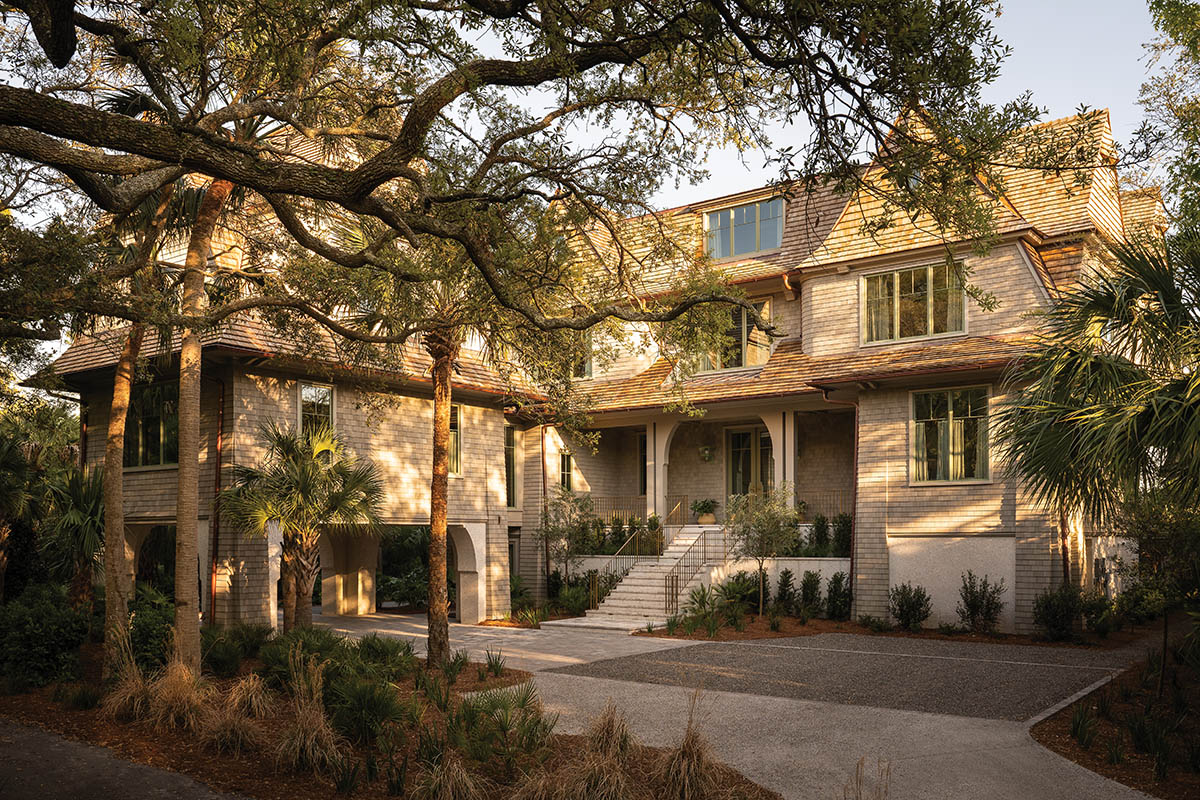
They assembled a local team—Cumulus Architecture + Design, Sands Construction, and landscape architect Wertimer + Cline, alongside Bishop—and gave them something rare: genuine creative freedom. “They were extremely trusting in our process,” Bishop notes. “That kind of respect and understanding allows us so much creative play.”
That freedom is visible throughout the shingle-style, oceanfront house that defies a single sensibility. It feels part Lowcountry retreat, part European salon, and part boutique hotel—all unified by Bishop’s unmistakable vision. “We wanted to bring a lot of fun, playful energy to the home,” says Bishop.
The star of the house is its open-plan living area, anchored by a sculptural, plaster fireplace studded with hand-crafted mosaic tiles—birds, botanicals, and tiny narrative fragments. “It’s the storytelling’s narrative of what I think modern fairy tales stand for,” Bishop says.
The fireplace is also a microcosm of the home’s design evolution. The designer cycled through ideas—tile, stone, and more—but felt it was “too monolithic and huge and harsh,” she says. Then, Bishop discovered a box of one-off mosaic tiles by an Etsy artist, each barely an inch across. Working with Faust Renovations, she transformed them into larger plaster tiles and set them into a textured surround. The result feels organic and intricate, as if excavated rather than installed. “It was a creative collaboration that I had no clue would land the way it did until the very end,” she says.
While open to the team’s creativity, the owners had clear priorities: a home equally suited for entertaining and retreating, a kitchen to feed a crowd, and an outdoor dining room for 20. Despite its scale—six bedrooms, two bunk rooms that sleep up to 10, and a top-floor primary suite that feels like a private hotel—the house doesn’t appear vast. Each of the three floors includes its own kitchenette and hangout space, and the top floor features his-and-hers offices with ocean views.
The layout allows the home to operate in zones depending on the occasion, offering private spaces for quiet times or drawing everyone to the central living/kitchen area or out onto the pool deck for communal fun. Those alfresco elements are key. “Every floor has its own unique outdoor space, each with differing vantage points of the ocean and each other,” explains Robbie Lesslie of Cumulus Architecture + Design.
The material palette is equally intentional, without a single painted Sheetrock wall. “It’s either shiplap, herringbone stained wood, tile, wallpaper, or plaster,” Bishop explains. “There’s this balance of materiality.” Public spaces lean architectural and calm—plaster, wood, stone—while private rooms embrace pattern, color, and whimsy.
The overall interior design combines Bishop’s love of pattern play with deep, grounding color. Because the wife adores wallpaper and lighting, the designer gave each bedroom its own visual identity while maintaining the foundational palette. For continuity, she used the same green trim (Farrow & Ball “Olive No. 13”) and custom drapery throughout, sheer panels from her collection with Holland & Sherry, woven with cream or green yarns. “They’re very tactile and artisan, while also calming.”
Bishop’s approach to combining patterns follows a precise logic. “It is a mix of organic and geometric patterns,” she explains. “The scale allows it to work, as long as the tonal colors are the same.”
In this house, color hums rather than shouts. Shades of green serve as the home’s neutral with hues of the oak canopies, marsh grasses, even the green-tinged Atlantic reflected inside. Warm stained woods reinforce the natural setting, and the checkerboard marble kitchen floor was chosen for its earthy quality. “It couldn’t look too polished or formal,” she notes. “It needed this earthen feel, like terra-cotta, but not too brown.”
Vintage pieces—nightstands, stools, chairs, and lighting—lend a lived-in feel. Bishop avidly collects objects with history and character, releasing them only when the right room appears. “It feels like they’ve got a life again,” she says.
The works of many artists further elevate the interiors. “It was like designing a boutique hotel,” Bishop adds. Wilfred Spoon’s quirky wildlife paintings nod to the Kiawah’s natural habitat, while a powerful figurative piece by Brooklyn-based painter Lizzy Lunday anchors the entry hall. Sculptural lighting by Anna Karlin adds jewelry-like accents to the living room.
One of the most personal layers came through Bishop’s rug collaboration with Amadi Carpets. She selected 13 yarn colors from the West Hollywood-based company’s 2,000-plus options and designed custom pieces inspired by her collection of 1920s and ’30s Swedish rugs. They debuted in the house before launching as part of her collection.
The result is a home that feels elegant yet relaxed, playful yet refined—a place where 20 can gather for dinner or the family can disappear for quiet time. They moved in last summer and were “overwhelmed,” says Bishop. “They were just so excited.” It’s a project Bishop muses that she may never create again. “I wonder if I’ll ever have another house like this,” she says. “It’s my favorite home I’ve ever built. It’s such a fairy tale.”