Hutty’s early works in Charleston include oil paintings of the outlying plantations, such as Magnolia Gardens (oil on canvas, 39 7/8 x 31 3/4 inches, 1920). “Although I loved the old town greatly, the magnificence of Middleton and Magnolia Gardens completely enthralled me,” he said in an interview in The Charleston Evening Post.
Alfred Hutty
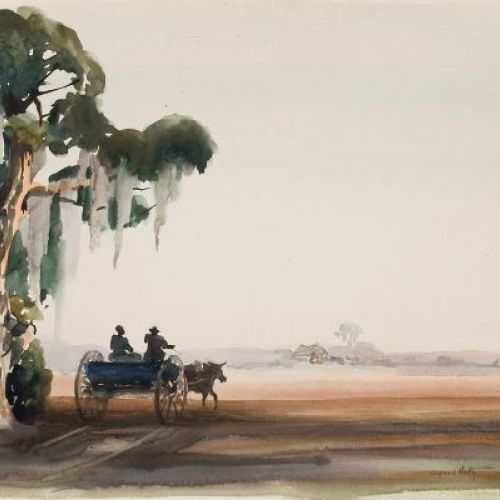
Day’s End, also known as Close of Day, (watercolor on paper, 18 x 24 inches, circa 1940); (inset) Alfred Hutty at the Gibbes Art Gallery in 1920
Hutty’s home and studio at 46 Tradd Street that he and his wife, Bessie, purchased in 1928
the artist with his dog, Peter
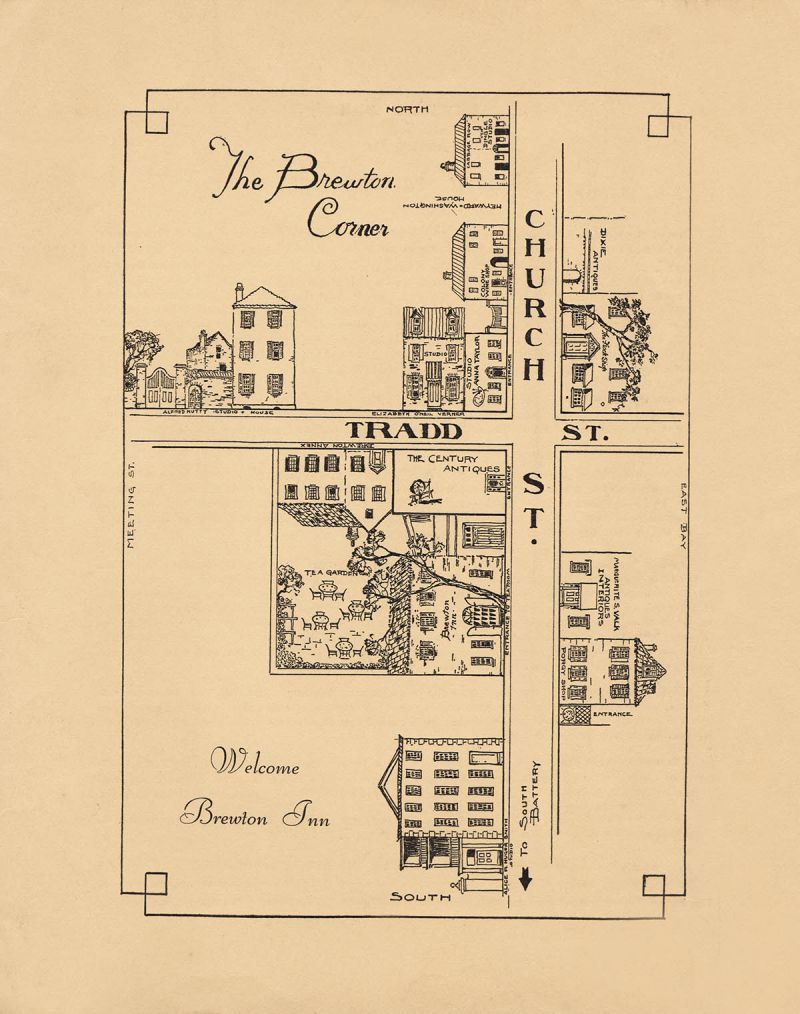
The Brewton Corner map, circa 1930, was published by the Brewton Inn to attract tourists interested in Charleston artists and their studios.
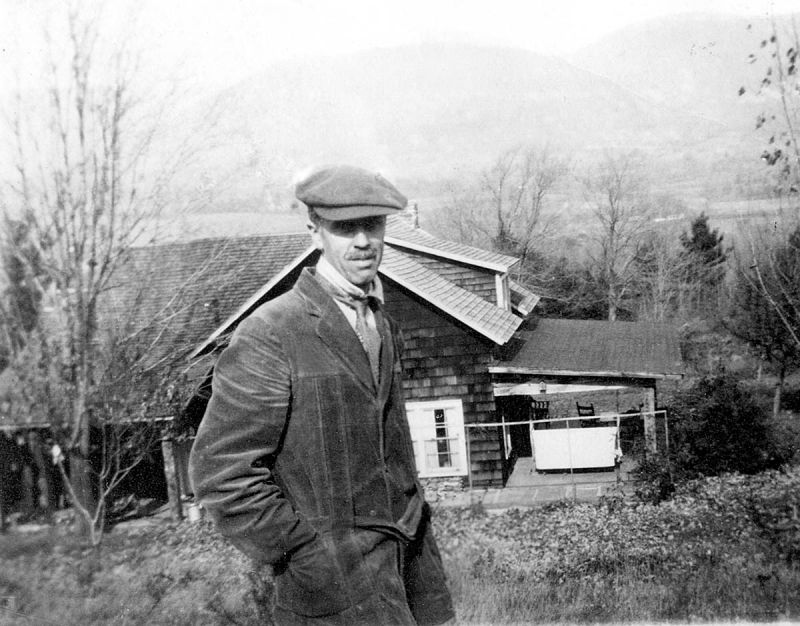
Hutty captured this wintry scene (Untitled, oil on canvas, 22 x 25 3/4 inches) in New York, where he followed landscape artist Birge Harrison in 1907. The artist (left) at Broadview, his 85-acre farm near Woodstock, New York, circa 1915
Hutty’s nature studies, especially his trees, such as An Avenue of Live Oaks (etching on paper, 6 x 7 1/2 inches, 1922), are considered technical masterpieces.
Hutty found inspiration in the city’s old churches and architecture, exempliefied by Meeting Street (oil on canvas, 23 1/2 x 29 1/2 inches, circa 1925)
The artist at his easel on Church Street
Unlike his contemporaries, Hutty more honestly depicted the lives of Black people living in Charleston, including this drypoint on paper, Jenkins Band No. 2 (10 1/2 x 9 3/4 inches, circa 1933).
In his “Rural Series,” Hutty moved towards more contemplative, pastoral scenes that included African American laborers. (Left) Rural South (drypoint on paper, 8 1/2 x 10 1/2 inches, circa 1938)
Deep South (drypoint on paper, 8 7/8 x 10 1/8 inches, 1937)
The Discussion Group, (watercolor on paper, 27 1/2 x 31 1/8 inches, circa 1946)
Author DuBose Heyward may have modeled the faults and failings of the protagonist in his novel Lost Morning after Hutty. Interestingly, the artist gave his drypoint of the same name (Lost Morning, circa 1936) for the dust jacket.
Phoebe Passes My Gate (etching on paper, 8 1/4 x 7 3/8 inches, 1931)
Back Street (Wash Day) (oil on canvas, 30 x 24 inches, circa 1950)
For the Attack on Fort Sumter mural for the Fort Sumter Hotel (9 x 18 feet, 1948), Hutty used actors from the Footlight Players as models, photographing them in Confederate uniforms. The original can be seen in the auditorium of The Charleston Museum; a reproduction graces the lobby of the Fort Sumter House condominium building at 1 King Street.)
Hutty in his studio with Bessie, circa 1935
Southern Villa (drypoint, 8 7/8 x 11 inches, circa 1948)
The Midwestern transplant helped elevate the city’s cultural identity in the 20th century