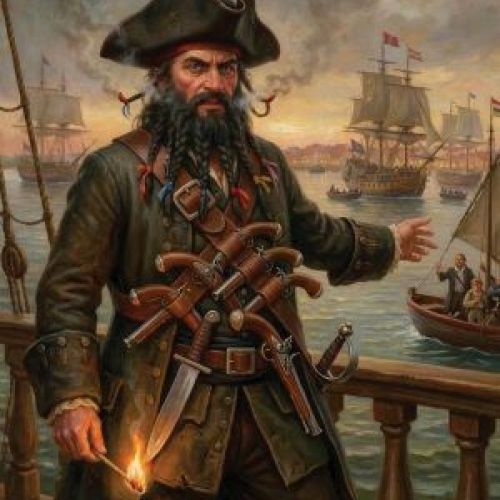
One of the most feared pirates in the Atlantic, Blackbeard—also known as Edward Teach or Thatch (circa 1680-1718)—terrorized shipping routes along the Carolina coast during the Golden Age of Piracy. In May 1718, he blockaded Charles Town Harbor for nearly a week, capturing vessels and holding passengers hostage until colonial officials delivered a large chest of medicines as ransom.
Known as the “Gentleman Pirate,” Stede Bonnet was a wealthy Barbados planter who abandoned his comfortable life for piracy in 1717. After joining forces with Blackbeard, Bonnet operated along the Carolina coast and took part in the 1718 harbor blockade. Captured on the Cape Fear River later that year, Bonnet and 29 men were brought to Charles Town, where they were tried for piracy, convicted, and hanged, making the city the site of one of colonial America’s most famous pirate trials.
Before radio communication, sailors relied on flags to identify ships and signal their intentions at sea. Pirates exploited this practice, often approaching under false colors before hoisting black flags adorned with skulls and skeletons to intimidate their victims. Some also flew red “bloody” flags, signaling that no mercy would be given if they resisted.
The inscription on the Stede Bonnet Monument in White Point Garden, near the site where the “Gentleman Pirate” and his associates were hanged in 1718.
Pirate activity map
A contemporary model of Blackbeard’s flagship, the Queen Anne’s Revenge, which resides in the North Carolina Museum of History in Raleigh.
Blackbeard the Pirate engraved by Benjamin Cole
Charles Vane carried out a series of raids on vessels entering and departing Charles Town Harbor in the late summer of 1718. Known for his audacity and skill at eluding naval patrols, he repeatedly escaped capture during his piratical career. His luck eventually ran out, however; after being captured in the Caribbean, Vane was tried for piracy and hanged in Jamaica in 1721.
Artist Jean Leon Gerome Ferris’s 1920 painting depicting the 1718 battle between Blackbeard and the Royal Navy in Ocracoke Bay.
Governor Robert Johnson
In 1718, Governor Robert Johnson dispatched Colonel William Rhett to hunt pirates, leading to the capture of Stede Bonnet on the Cape Fear River.
Blackbeard's severed head hangs from Maynard's bowsprit, as pictured in Charles Elle's The Pirates Own Book.
The Pink House, where Anne Bonny’s father lived.
The Nicholas Trott House
Pirates used false flags to lure ships within range before revealing the Jolly Roger and striking. At trial, Rackham was noted as having flown a white pennant on his sloop.
John “Calico Jack” Rackham engraved by Benjamin Cole
Alongside Anne Bonny, Mary Read avoided immediate execution because she was pregnant and died in prison the following year. Engraving by Benjamin Cole
Believed to be the illegitimate daughter of a local merchant, Anne Bonny spent part of her youth in colonial Charles Town before becoming one of history’s most notorious pirates. She sailed with “Calico Jack” Rackham and fellow pirate Mary Read, raiding ships in the Caribbean and along the Carolina coast. Captured in 1720, Bonny escaped execution due to her pregnancy, and her ultimate fate remains unknown.
Read up on Blackbeard, Stede Bonnet, and other pirates who terrorized local waters