See the ”Monuments” art projection nightly from February 27 through March 31
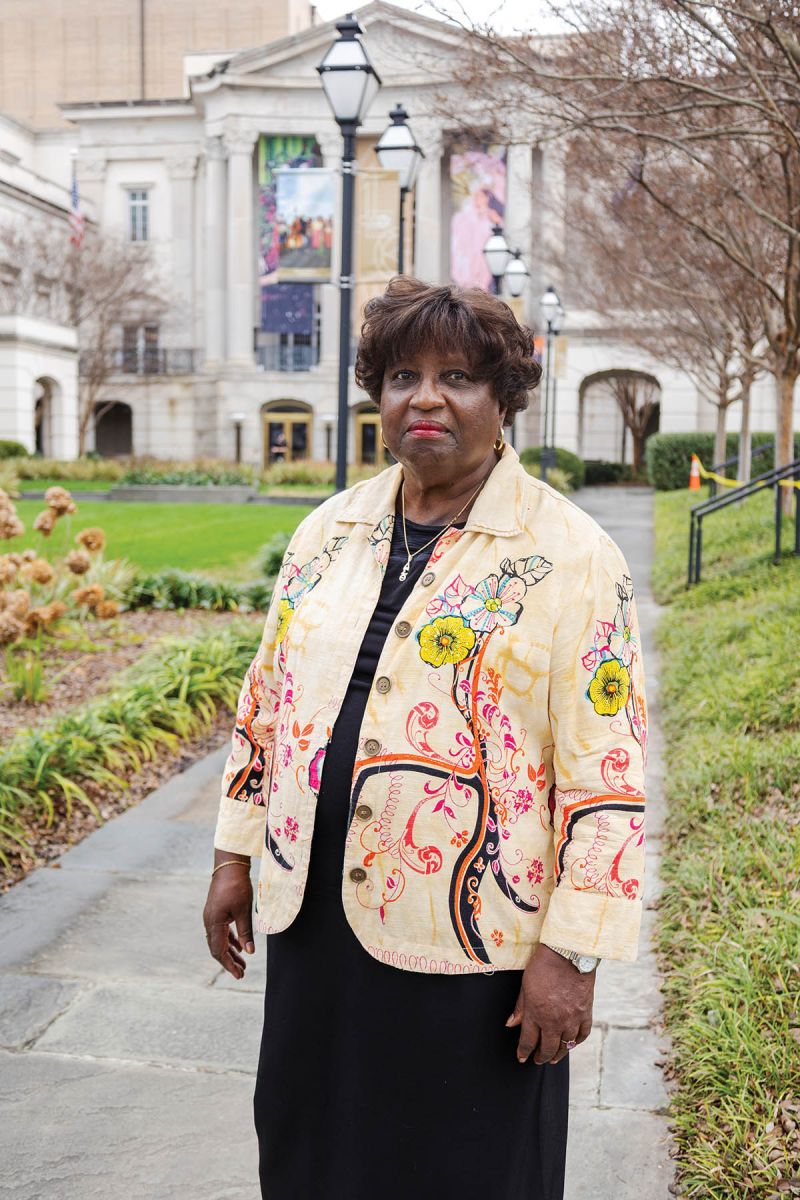
When it comes to knowing one’s neighborhood, few can claim to have reached the level of knowledge gathered by Diane Hamilton, an industrious retired educator who has called the same street home for more than 80 years. From the lot where she grew up, Hamilton watched the development of West Ashley’s historic and predominantly Black Maryville-Ashleyville community, which inspired her to research, write, and publish Maryville, The Audacity of a People (BookBaby) in 2021.
The desire to “want to know more” was a trait Hamilton instilled in her students during more than four decades teaching history in Charleston County schools. “I never wanted the classroom to be dull,” she says. “Some people can teach the same thing for 50 years; I didn’t want to do that.” After starting out at the all Black W. Gresham Meggett High School in 1966, Hamilton went on to be one of a few African American teachers at what is now James Island High School when it merged with Fort Johnson High School in 1983. Her academic career continued with stints at the Charleston County School of the Arts and Baptist Hill High School, until she “got retirement right” in 2008.
This month, as part of its 10th season, the Charleston Gaillard Center unveils artist Craig Walsh’s “Monuments,” an outdoor exhibit that projects large-scale videos across trees outside the performance hall. Among the featured portraits of “unsung local heroes” will be Hamilton, one of three community members who are being honored for making a positive impact “through service, creativity, care, and leadership” during the nightly installation.
CM: How did your teaching career evolve over the years?
DH: My first teaching assignment was at 20 years old at Gresham Meggett, with all Black faculty and students. I worked there for three years until it closed in 1969. After that, I moved to Fort Johnson. In 1983, they merged with the old James Island High School. When the student body and faculty came over, I was one of only three African American teachers. The other two had master’s degrees as high school teachers, and that was almost unheard of; didn’t matter if you were white, Black, green, or orange. I served for 17 years there and tried to retire in 1999. That lasted only a few weeks.
CM: What inspired you to write a book about the neighborhood you grew up in?
DH: It took me a while to understand what retirement meant. On my fourth try, I asked the question, “What did my neighborhood look like before the construction of Highway 61?” I started interviewing older citizens who had lived in the Maryville and Ashleyville neighborhoods on either side of St. Andrews Boulevard. Then, I went to the Avery Research Center to look at records, because I wanted to pass this information on so someone else could build on it. My intentions weren’t to write a book; I just wanted to preserve the material. Now, I could write a second edition. Local history had never been my interest before; it had always been ancient and European. But my neighborhood got me interested. Knowing what I know now, I wish I’d had more conversations with my parents. I have so many questions I would have loved to ask them.
CM: Were you surprised to be selected to participate in the “Monuments” exhibit?
DH: I was nominated by my friend Donna Jacobs, a collaborator who has also done years of research on West Ashley, and I said okay because I didn’t think they’d pick me. This is all new to me. I’m comfortable promoting others, rather than self-promoting. What I do is normal, or should be; it’s what we’re supposed to do as good humans and citizens. You do the best you can and try to improve upon each model.
CM: How do you serve others now that you’re no longer teaching?
DH: I don’t get paid anymore, but I’m still involved in many projects, including my neighborhood association, where I served as president for 10 years, and Mayor Riley’s committee to plant 10,000 trees. I also do work through my sorority, Delta Sigma Theta; I’ve been with them for 30 years. Things just walk into my life, and I don’t say no. I take each as a challenge and continue growing.
Age: 81
Lives: West Ashley
Education: Bachelor’s degree from South Carolina State, master’s from The Citadel
If you go: See “Monuments” nightly beginning at 6:30 p.m. outside the Charleston Gaillard Center through the end of March