Learn more about Tyler Rollins’s Foundation for Spirituality and the Arts in Harleston Village
In a peaceful room of a former kitchen house constructed of old Charleston bricks, textile artist Amina Ahmed is taking her afternoon tea. She has thoughtfully arranged a corner of her studio floor, placing an elegantly composed tray of ceramic cups, a mound of nuts, and an assortment of biscuits. She eases down next to the offering, serenely sitting cross-legged with enviable grace. From the simply composed tableau, it is clear the artist is a consummate host. However, while in Charleston, Ahmed has trained her focus on being the consummate guest. “Are we not guests of God in this world?” she reflects.
Ahmed is one of two fall 2025 artists in residence with the Foundation for Spirituality and the Arts (FSA), a nonprofit based in New York and Charleston that supports contemporary artists whose practices engage with spirituality or faith traditions. For Ahmed, a devout Muslim, the invitation feels as meaningful as a devotional calling. For FSA founder, Tyler Rollins, the residency is the embodiment of a long-held goal: to create intentional space where the creative and the sacred may converge.
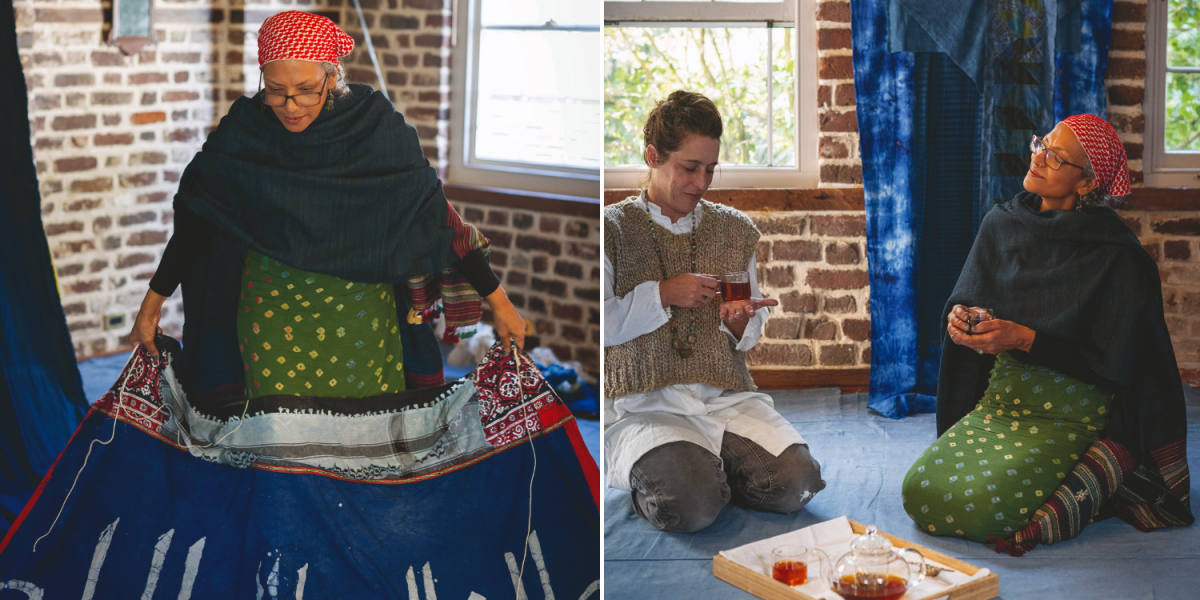
Meet FSA fall 2025 artist in residence Amina Ahmed:
Rollins’ own professional arc informs the foundation. Before starting FSA, the North Carolina native led Tyler Rollins Fine Art and, beginning in 2008, a New York gallery that specialized in mid-career artists from Southeast Asia. In 2020, he stepped back from day-to-day gallery operations to concentrate on advising private collectors and museums. Those years revealed a pattern: many of the artists he represented drew heavily on their spiritual backgrounds, but that was rarely acknowledged in gallery or museum contexts. “Our artists were almost evenly divided between those with Buddhist, Christian, and Muslim faith backgrounds, but this was not typically the lens through which their work was viewed in the New York art world,” he says. “Many artists often told me that no one had asked them about these questions, and some curators admitted that they lacked a language to discuss spirituality in contemporary art.”

Convinced the topic deserved more attention, Rollins decided to build a national platform that could nurture connections between the contemporary arts and notions of higher purpose, in whatever form they may present themselves. “I view spirituality as a continuum ranging from a personal, idiosyncratic approach to the more organized, communal aspects seen in various religious traditions,” he explains.
The resulting program has a threefold purpose, says Rollins, “to nurture artists who are interested in delving deeper into spiritual issues, to enrich Charleston’s cultural life, and to have a wider impact nationally and globally.” Over the past four years, the nonprofit, which is reliant on philanthropic support, has welcomed artists to Charleston from many religious traditions, as well as those whose spirituality is more cosmically framed. Participants apply by invitation, then undergo a lengthy review process that includes interviews and studio visits, for two six-week residencies each spring and fall. “FSA is focused both on fostering discourse and on supporting creative initiatives, particularly through our residency program in Charleston, which I hope will act as a national model for engaging with artists and communities through the spiritual lens,” says Rollins.
Rollins first came to love Charleston in the mid-1970s and returned often. In early 2021, he purchased a house in Harleston Village, drawn to the neighborhood’s mix of students, families, and artists. “After living in Manhattan for 30 years, I was eager to reconnect with the Carolinas and also to work on community engagement through the artists in a smaller community,” he notes.

From the sidewalk, the residence reads like the similarly spit-and-polished historical homes nearby. Smartly refreshed by his pristine restoration, the circa-1870 property enfolds a traditional cluster of main, kitchen, and carriage house structures, as well as a lush, private garden sequestered by swaying bamboo. The property’s intimate architecture—piazzas, outbuildings, and shaded paths—creates a sense of a small artist colony tucked inside the historic district.
Here, Rollins’s local team—manager Keller Hollingsworth and Tushara Bindu Gude, a former curator at the Los Angeles County Museum of Art—runs the residency program. Chosen artists are housed in two outbuildings on the historic property—separate studios and bedrooms, plus a communal kitchen and dining area—spaces that encourage both contemplation and exchange. “Artists really appreciate these very unique spaces that are a far cry from the usual generic white box,” says Rollins.
In Charleston, the FSA artists become visible through their daily habits: wandering streets, their eyes trained on architectural details, intently gathering palmetto fronds as if collecting rare treasure, or lingering in a church pew, rapt by the rhythms of a newly discovered hymn. Some arrive from London, some from the Philippines, and others from Mexico. All arrive curious.
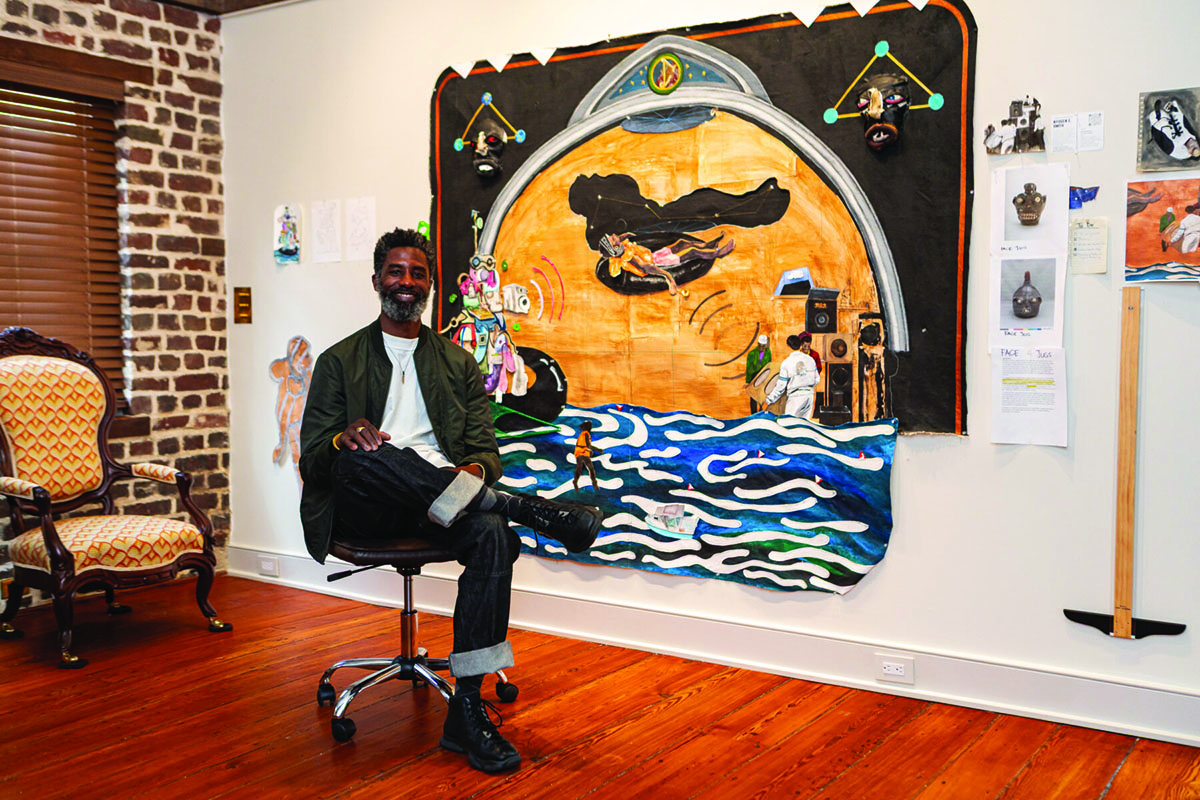
New Jersey-based expressionist Genesis Tramaine, the other fall 2025 resident, calls herself a devotional painter. She creates abstract portraits of figures who transcend gender, race, and social hierarchy, often through the lens of biblical allegory. Her work has shown internationally at museums like Spain’s Museo Picasso Málaga and can be found in the collections of Washington DC’s Hirshhorn Museum and National Gallery of Art and the Rubell Museum in Miami.
In Charleston, Tramaine focused on a self-portrait, delving into her roots in nearby Allendale. Seated at the kitchen house’s dining table on an October afternoon, she pored over an old family photo album, tracing stories of her relatives who once lived there. The artist frequently works with paper and has since childhood, when she was handed “hush” hymnal books during Southern Baptist church services and urged to channel her energy on their blank pages. “I would sketch and sketch and sketch, and I was quiet, and the gospel was so soothing, and I didn’t get in trouble,” she notes.
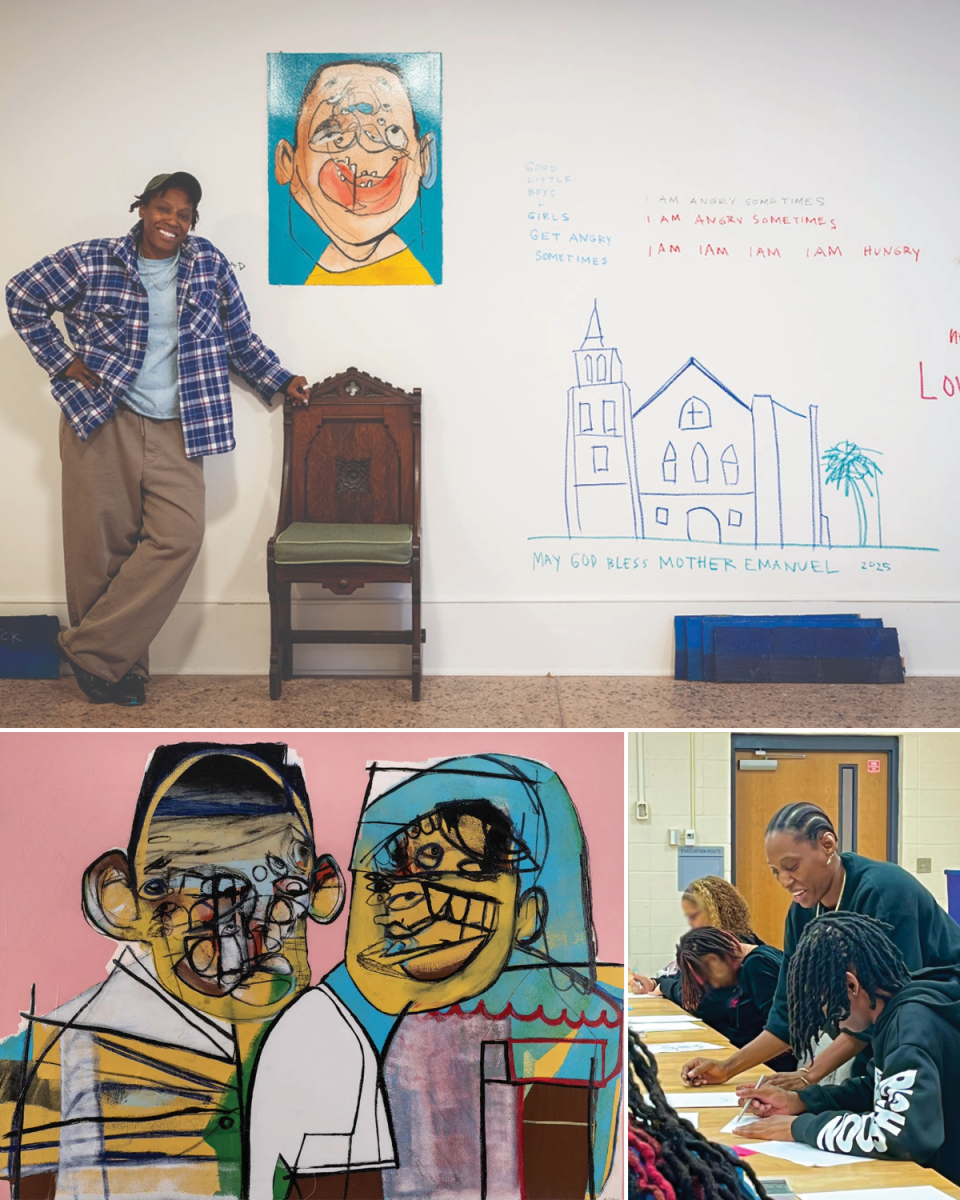
Paper remains a mainstay of her practice. While in Charleston, she collected materials during every outing—napkins, menus, brown paper bags—items that connect her to the people she met. “I like the way paper feels in my hands. I like the way it tears. I like the sounds of the tears. I like the roughness of it,” she says.
During her residency, Tramaine spent four weeks with seniors at Burke High School, teaching the fundamentals of portraiture and asking them to sit in self-reflection as they navigate the tricky transition to adulthood. “You really have to sit with self, and that’s usually uncomfortable for students,” she says. She did the same herself, reconnecting spiritually by visiting churches, including a Bible study at Mother Emanuel AME Church, and connecting with people during frequent forays around the city. “Under my hat, I’m listening more than I’m speaking,” she muses, patting its top.
Hear from artist Genesis Tramaine about her fall residency at FSA:
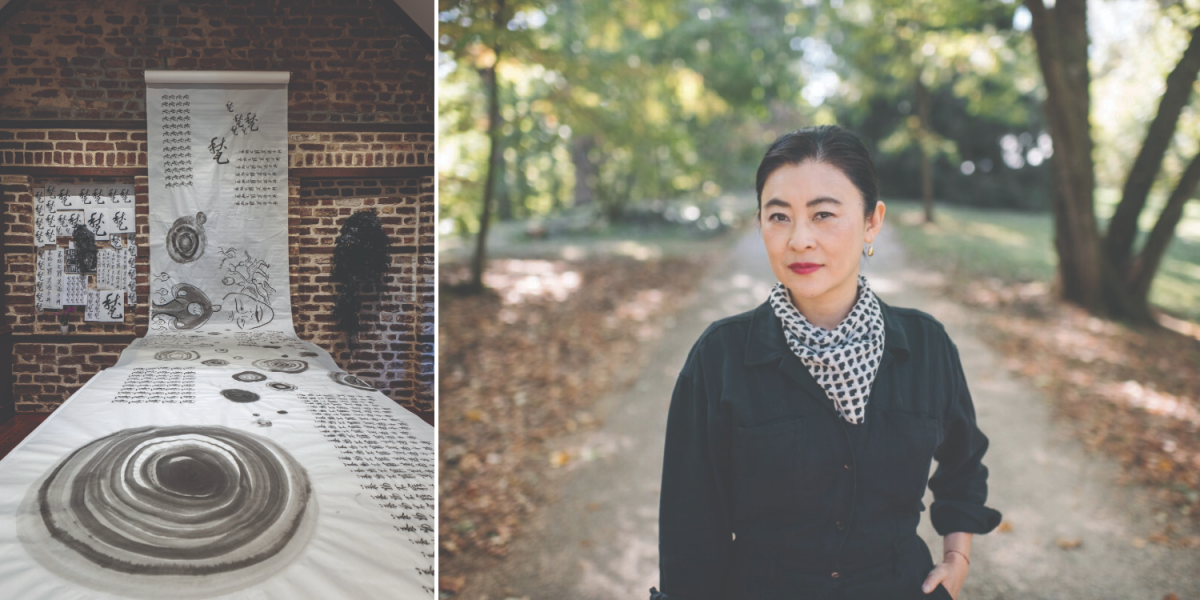
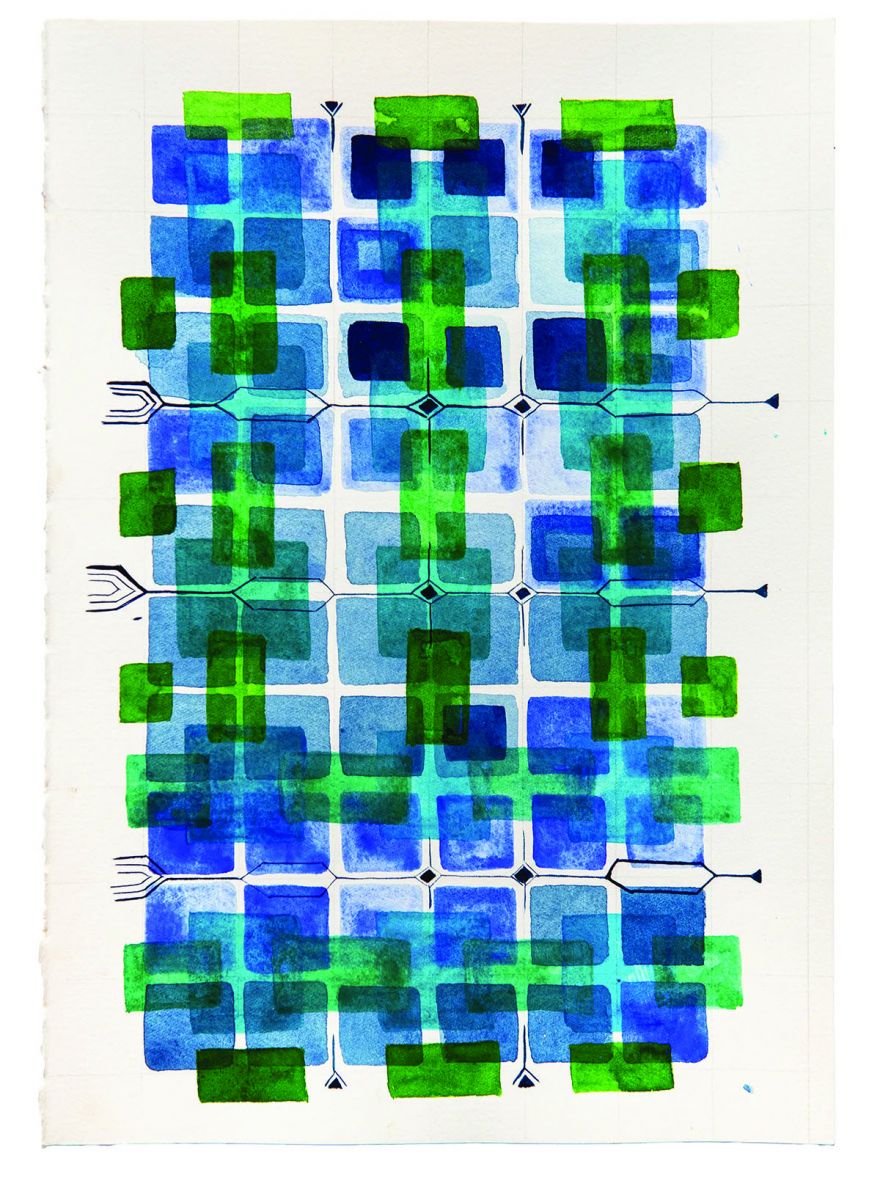
Three weeks into her residency, Ahmed has become equally immersed in her Lowcountry environs, absorbing the city’s stories and material traces. Her studio is filled with textiles and papers imbued with meaning: a velvet cloth from Uzbekistan, a swath of fabric she painted while at The Royal College of Art (where she studied Visual Islamic and Traditional Arts), and a book of embroidery made by her mother, who taught her the craft.
Like the divergent materials, objects, dyes, and curiosities that peacefully coexist within the studio, Ahmed draws from a wide-ranging background. Born in East Africa, of Kutchi-Indian, Turkic, and Nubian heritage, she grew up in England and has lived in Iran and the US. She offers up a small container with a chunk of indigo, noting its distinct smell and its role in the city in which she has landed, as well as its journey she can track along the Silk Road.

On the studio floor, she has laid out works on paper involving patterns informed by folk art and geometry in nature. “I want to write poems about my love for God through patterns, through colors, so that anyone can read them no matter what language they speak,” she explains, adding that her hope is to “speak about the hardships without making someone feel the hardship.” What is particularly striking about her practice is the purity of its aim: While she loves showing her work, her overarching aim in creating it is being close to God.
After four years of residency programming, Rollins said that the ripple effects of FSA’s presence have been widely felt. To date, 18 residents have participated, many of whom have engaged with the community, from performances, workshops, and installations at local houses of worship to collaborations with arts organizations, including the Halsey Institute of Contemporary Arts.
One shining example will be unveiled this spring at Calvary Episcopal Church on Line Street—the result of London-based multimedia visual artist, musician, and curator Graeme Mortimer Evelyn’s 2023 residency. The artist, who has previously engaged with places of worship, creates works that serve as dialogues, often involving contested histories and heritage. Among them is a London Diocese commission, the creation of The Eternal Engine, the largest permanent hand-sculpted contemporary altarpiece in Europe, for St. Francis Church in Tottenham Hale, England.
Past artist in residence Graeme Mortimer Evelyn discusses FSA’s unique importance in the world:
Evelyn’s local lecture for the Episcopal Diocese led to a conversation with Calvary and a subsequent collaboration to create The Calvary Icons, a permanent contemporary altarpiece that is in its fundraising phase. To be fashioned from medium-density fiberboard, the piece’s swirling forms and colors will complement the sanctuary’s iconic 20th-century stained-glass window above the altar and were developed through careful listening and local engagement. “I have to go out of my way to build trust…. I’m always listening, and I can repeat back quite confidently what [the church’s] challenges are,” Evelyn notes. The artist, whose family is originally from Jamaica, has gained a deeper sense of the Caribbean connections in Charleston, spending part of his time in the Lowcountry.
At the end of each residency, FSA hosts a garden party to honor the artists and to share the work they have created. On a Saturday in early November, Tramaine and Ahmed wander through, eyes lighting up as new friends from recent weeks arrive. They are joined by scholar-in-residence, New Jersey-based curator Tumelo Mosaka.
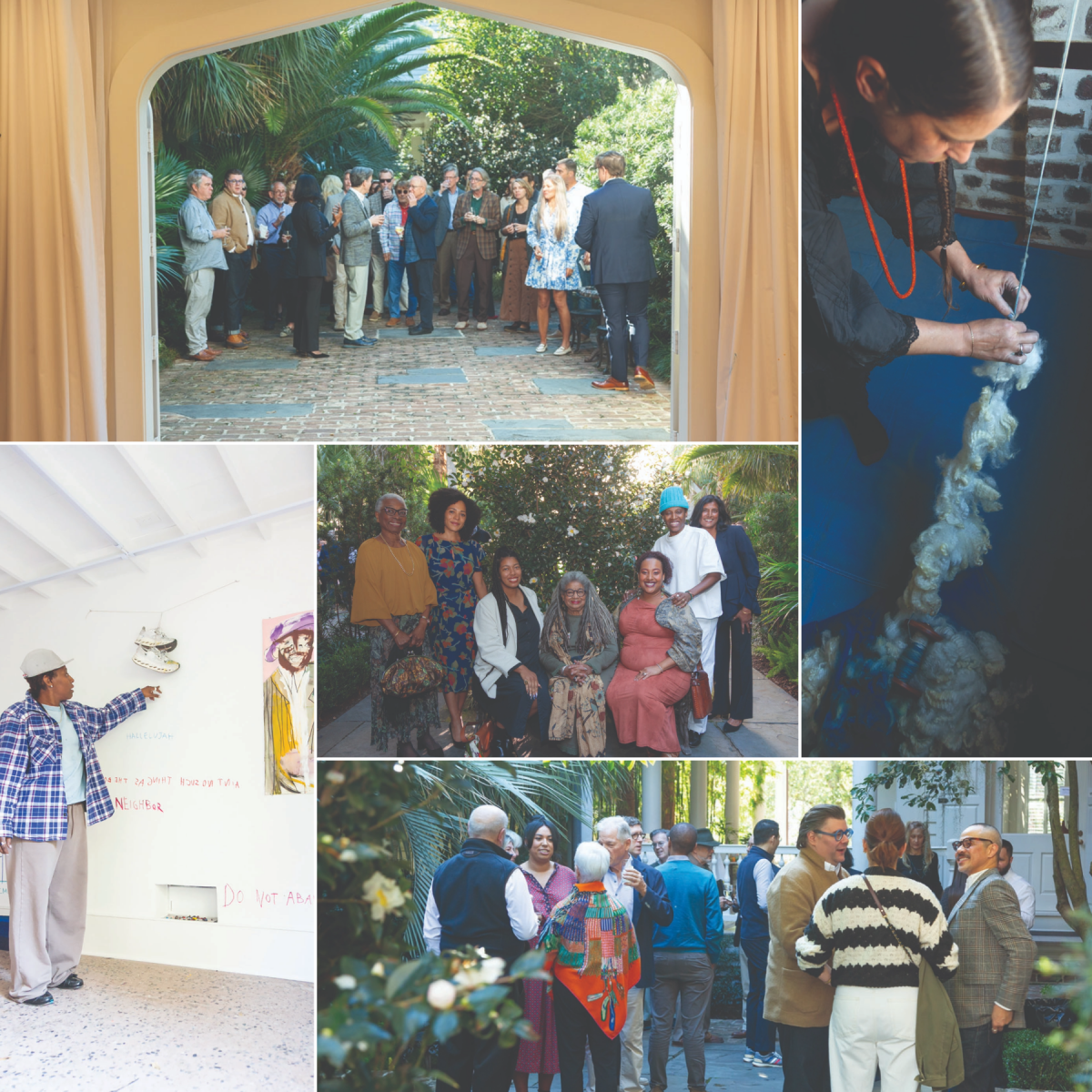
The artists have been busy. Guests are beckoned first to gather in Tramaine’s studio. Self-portraits gaze out from bright backgrounds. Sneakers are hung by their tied laces. Tramaine’s convictions are written in colored marker nearby: “Hallelujah.” “I ain’t afraid no more.” “Progress is not always pretty.” The artist emerges from a door, offering a mesmerizing chant that seems to spring from the deepest place in her soul. After several minutes, her eyes greet the crowd that encircles her.
Upstairs in her studio, Ahmed ushers in small groups. In the darkened, hushed room, they gather to hear reflections on her immersion in Lowcountry indigo-dyeing and connecting with celebrated textile artists such as Arianne King Comer and Torreah “Cookie” Washington. By her side is a newfound kindred spirit, Precious Jennings, a Charleston-based artist working with indigo dye, sewing, performance, and movement. With blue-stained fingertips, each gestures to fabrics that flow from the walls in shades of cobalt, azure, and sapphire. Ahmed delves into the spiritual roots of her work, her voice as soft and rich as the swaths surrounding her, lulling the room into an altered state.
Such transcendent connections are doubtless guided by the marked spirit of these visitors who each embrace the residency and the city with an artist’s sensitivity. And, with skill and reverence, each makes an uplifting mark on the city—a gift for which Charleston will be transformed, too.