Meet the Dublin-born dynamo who leads the Charleston Literary Festival


The bar upstairs at The Peacock on East Bay was packed. It was the week after Labor Day, and Charlestonians, fresh back from summer travels, were eagerly catching up with friends and comparing notes on the busy fall calendar ahead. The Charleston Literary Festival (CLF) in early November is one of the first big events on the docket, and the evening marked the program reveal and ticket launch, with The Peacock’s speakeasy ambience accented with displays of featured authors’ books. Speaking, however, proved not so easy, given the crowded room full of chattering attendees and no podium. So how did the festival’s new executive director get people’s attention? Well, she hopped up on the bar, of course. Dressed in a perky green pantsuit, Sarah Moriarty perched herself atop the bar and poured out her uncorked effervescence. Her sapphire eyes all a-sparkle and her Irish brogue chipper and bubbly, she’s human champagne—if champagne could read and quote Beckett.
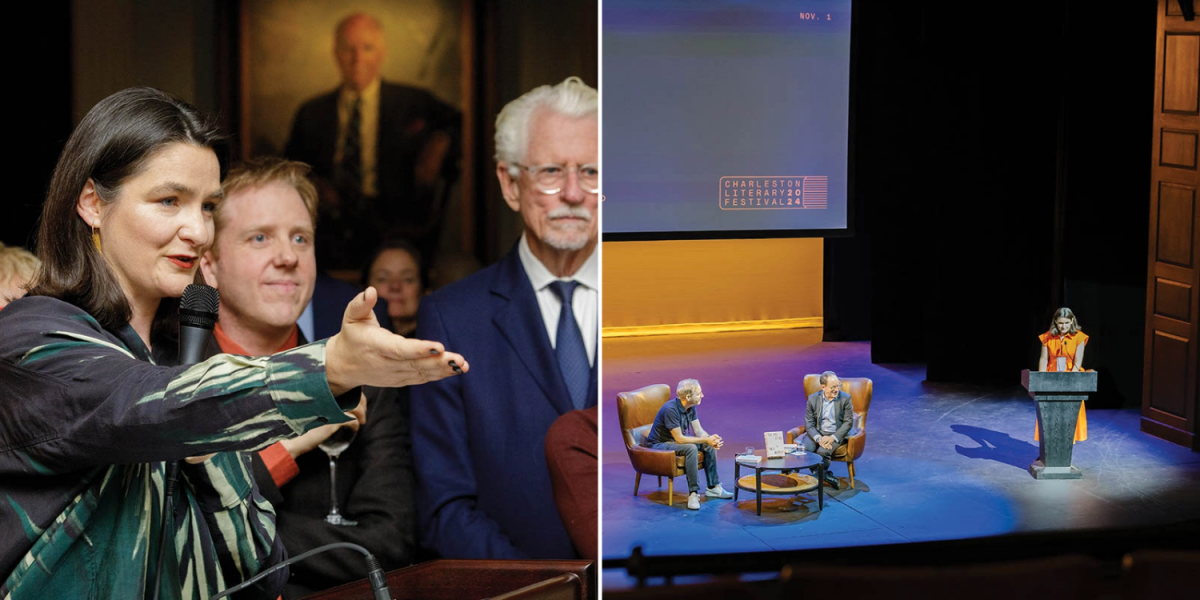
“We’re on a mission to connect people, to connect a diverse group of international authors and readers through books and big ideas,” said Moriarty, quite literally sidesaddled up to the bar. Her hands gestured fervently, dancing in lively, bright swoops as she sat, green legs crossed, and pumped up the program highlights—some 35 authors, including Margaret Atwood, Richard Ford, and fellow Irishwoman Claire Keegan, among others. Her enthusiasm was intoxicating.
That was back in 2023, the first year that Moriarty assumed the reins of the then-seven-year-old festival, and she was as confident and gung ho then, fresh out of the gate and still a relative newcomer to Charleston, as she is now, heading into her third season. One of Moriarty’s primary responsibilities is determining the roster of authors, books, and topics, as well as the corresponding “interlocutor”—the person paired with each author, engaging them in conversation—which she hashes out alongside festival cofounder and now senior artistic adviser Diana Reich. The goal is “to offer something for everyone,” Moriarty explains, “to create a highly curated program that will challenge people. We go after excellence, looking for who is best in their genre right now, as well as what’s relevant to this moment.”
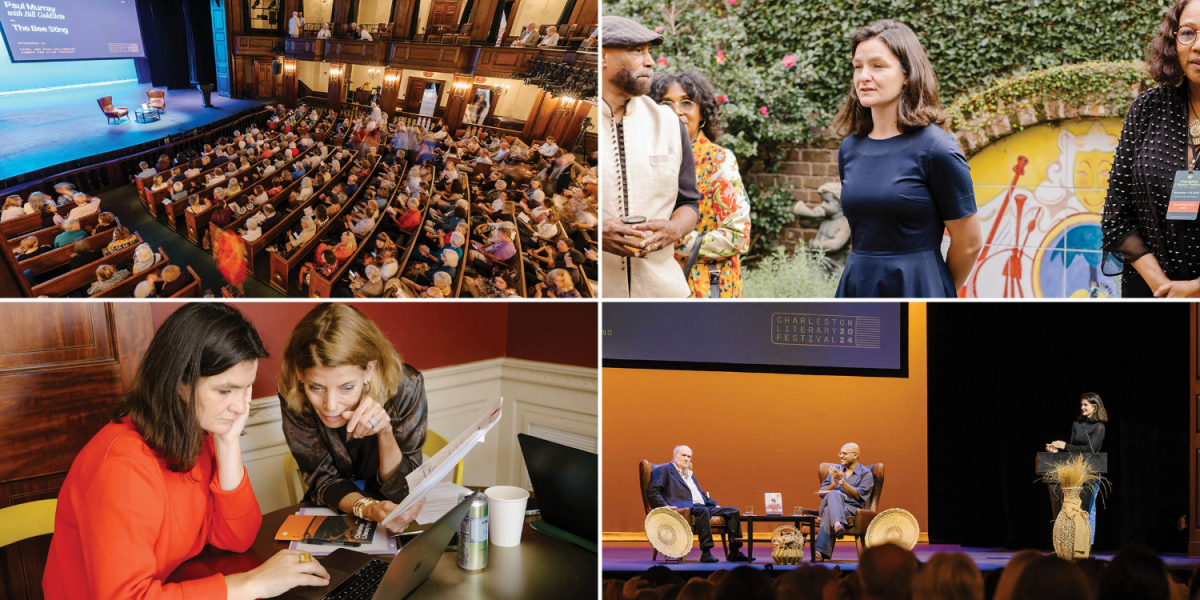
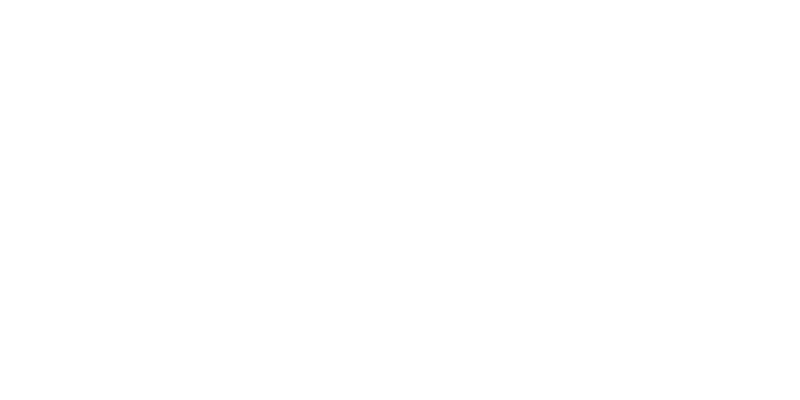
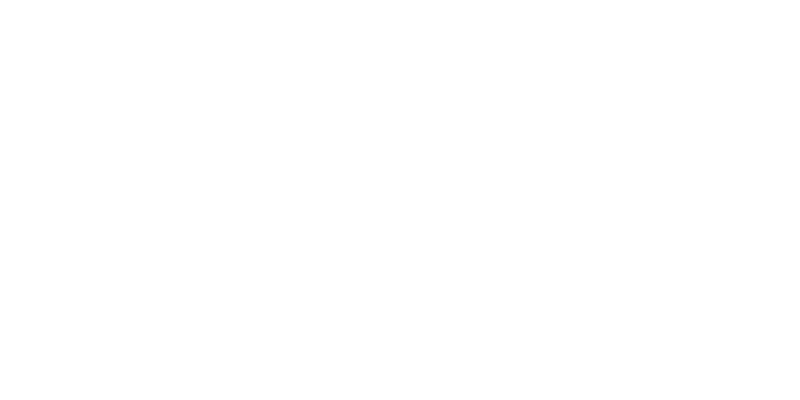
This year, what’s relevant runs the gamut from human rights intrigue to American political history to women in science and a dash of Jane Austen, from an all-star billing that includes literary lions like Joyce Carol Oates, Michael Cunningham, David Blight, Gish Jen, and The New Yorker fiction editor Deborah Treisman, as well as Charleston’s own prime-time socialite Patricia Altschul paired with Marc Cherry, creator of Desperate Housewives. For 10 days this November, they and others will hold Dock Street audiences in thrall solely by the pyrotechnics of conversation.
If your notion of a literary festival is all highbrow and heady, then you haven’t yet discovered that Moriarty was the mischievous Catholic school girl from Dublin who pulled pranks on the dean, trading out framed desk photos of his twin sons with photos of her and her classmate. She once connived to steal the handbell that the nuns used to signal time to change class–“without which the whole system breaks down into mayhem and havoc,” she says. “I never laughed so much as I did in those school days. We were very, very subversive.”
Yes, she was smart and studious—a literature nerd who loved James Joyce and Samuel Beckett and cofounded her high school’s debate society, competing impressively in national debate championships—but she also knew how to have fun, and still does. Parties are a central part of the festival, like 2023’s sold-out medieval feast of Anglo-Saxon delicacies (juniper-spiced boar meatballs, anyone?), inspired by author Bernard Cornwell’s best-selling Last Kingdom series. Or the “Feasting with Books” dinner parties hosted in various homes around town to raise awareness and support for the festival, “and to spark conversation,” says Moriarty, for whom conversation comes readily—and with plenty of spark.
The 39-year-old mother of two, whose energy seems boundless despite keeping up with her three- and five-year-olds while planning a 10-day festival, is clearly enjoying her role and her busy, chaotic, highly conversive life. Moriarty’s husband, Mena Mark Hanna, is general director of Spoleto Festival USA, so their lives are bookended in spring and fall by spearheading multiday events with complex logistics and lots of babysitters. “The Irish are a lot like Charlestonians. We’re welcoming, we’re having fun. We want to tell you a story, and we want to bring you in. We want to know everything about you, and we’ll tell you everything,” she says, telling me everything over a hunk of delicious cheese and salami she’s just picked up at Lillian’s, the corner market by her home on Charleston’s West Side.
It’s her daughter Banba’s first day of preschool (older brother Hugo started kindergarten a few days before), a day when most moms would savor a morsel of precious solitude after summer’s relentlessness. Instead, she welcomes me in, past the upright piano in the foyer and the wall stacked floor-to-ceiling with books, past Aggie, the expressively scruffy mutt named after Agatha Christie. Moriarty keeps me fully entertained for two-plus hours, tracing her trajectory from Dublin, where after high school shenanigans she went on to study literature and film at Trinity College, then to Paris, then Berlin, and finally to Charleston.
At university, she wrote a column for the Trinity News and made short films—a Godot-like horror flick about waiting for a bus—as a member of the film club. During her third and fourth years, she lived with two drama students and fell in love with theater and performance, eventually writing her dissertation on Irish mythology in the theater of Marina Carr. “I was reading the dramatists. I was reading Irish literature—Joyce and Beckett and Brian Friel—the modernists like Eliot, Pound, then the absurdists like Ionesco. We were obsessed with Ionesco. I was a college student, and I was mad for it, the whole kit and caboodle,” she says. That voraciousness has stayed with her.
“Sarah’s love of literature—and its power to connect people—was active and alive in our college days,” says her former housemate and now accomplished Irish playwright Shane O’Reilly, who is on this year’s CLF docket. “Whenever a book moved her, she couldn’t keep it to herself. She’d rush in, as if compelled by some external force, asking us to listen as she read aloud, eager to share the beauty, the revelation, the polemic. Sometimes, she’d offer the book to one of us, so she could hear how it sounded in another voice. That’s Sarah—bursting with generosity, always reaching out, always connecting.”
Immediately after graduating in 2008, Moriarty moved to Paris. “I wanted to just roll around in the world a little bit, you know. I had this wide-eye view of Paris as this fantastical literary city where Joyce and Beckett had been, and all the Americans. It’s all so cliché, but there’s a reason it’s cliché,” she says.
On day one, she says, “I did what Irish people do; I got a job at an Irish pub.” When not slinging Guinness, she frequented Shakespeare & Company, the famed bookstore on the Seine, where she hung out with the “Tumbleweeds,” poets and writers who lived in bunks above the store. Eventually, she landed a job working for a French photojournalism agency, expanding her creative cohort to include world-famous photographers. She’s fluent in French thanks to housemates, a theater designer and an illustrator, who hid the fact that they spoke English. After three years in Paris, Moriarty applied to a master’s program in international comparative literature at the Free University of Berlin, moving there in 2010. “It wasn’t the most informed decision I’ve ever made,” she admits, “but I wanted to study more, I wanted to progress, and Berlin was very cool then. I thought, ‘Let’s figure out this new city.’”
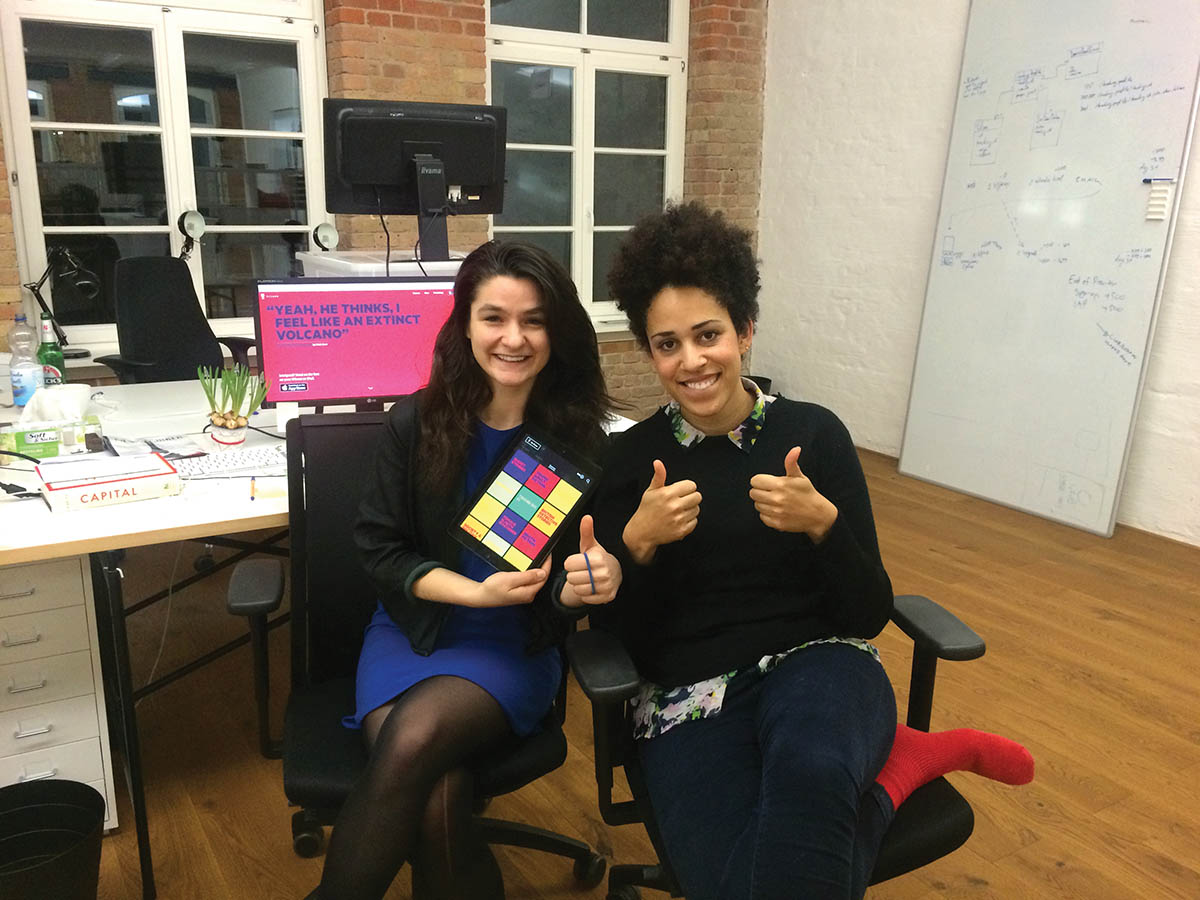
In Berlin, she wrote a dissertation on Beckett while discovering her aptitude for branding and marketing for various start-ups. “Silicon Allee was Berlin’s burgeoning tech movement,” she explains, and, ever curious, she dove in, working first for the health app, Noom, then working her way up to global director of brand for Blinkist, an app that distills text and audio key ideas from nonfiction. “So I was in this literary publishing space but at the edge of new technology,” says Moriarty, who loved interacting with authors and helping develop a Blinkist podcast and magazine. She also found the start-up ethos ripe for honing leadership and management skills. “It was this incredible professional boot camp. You’re given a lot of responsibility early on in a safe, high-paced environment. People trust you to experiment. You grow by making mistakes and then keep going.”
The world of apps, it turns out, had other benefits. Moriarty and Hanna met on Tinder in November 2015. At the time, he was a founding dean and professor of musicology and composition at Berlin’s Barenboim-Said Akademie, a conservatory dedicated to the vision of conductor Daniel Barenboim and literary critic Edward Said. On an early date, Hanna took Moriarty on a private hard-hat tour of a major construction project he was overseeing. “If you ever want to impress a girl, I recommend trying, ‘So let me show you around like this incredible, world-class Frank Gehry concert hall that we’re building,’” she laughs.
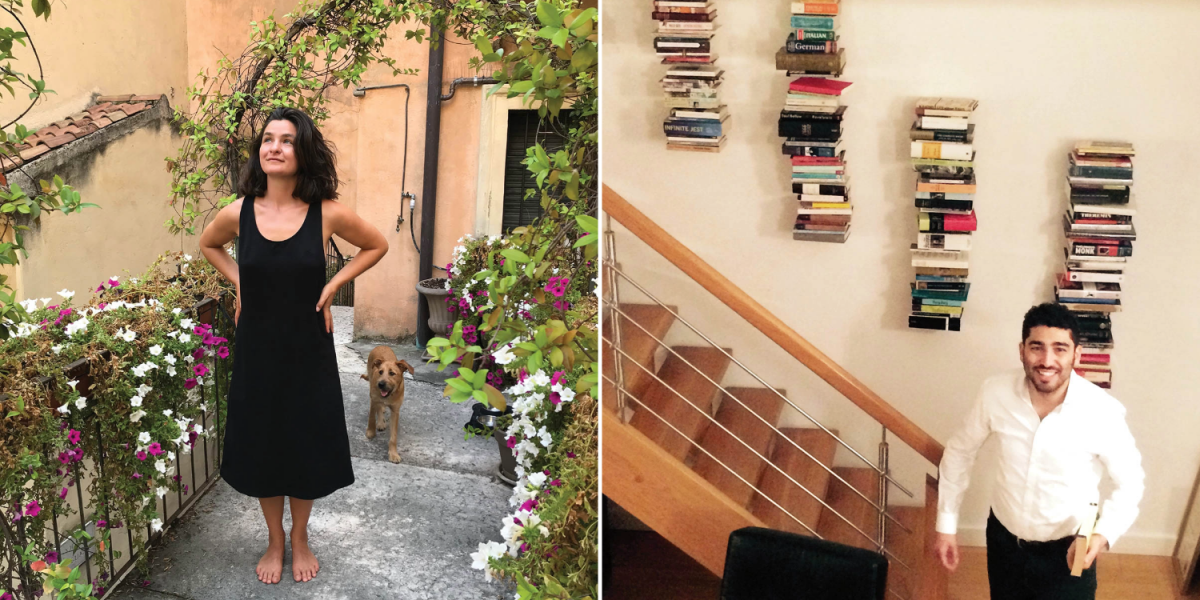
It worked. It also helped that Hanna, foreshadowing his Spoleto directing prowess, proved adept at orchestrating creative dates (a bike tour to a café and jazz concert then a Botticelli exhibit, followed by a home-cooked dinner). “That was my pet peeve. I mean, if you can’t organize a date, how can you raise a family?” says Moriarty, smitten early on. “I would have married him straight away because I’m so impulsive and spontaneous. Mena is more steady.” When the two did marry in 2019, they danced to Rihanna’s “I Found Love in a Hopeless Place,” because, explains Moriarty, “not only did we meet on Tinder, but on Tinder in Berlin, which seemed doubly hopeless.”
When the young couple and 18-month-old Hugo arrived in Charleston in October 2021, the literary festival became their de facto Holy City introduction. Reich, a cofounder of CLF from its early days as the US offshoot of the UK’s Bloomsbury Charleston Festival, had reached out while Moriarty and Hanna were still in Berlin and introduced herself. “She’d read about Mena coming to Spoleto and me working in publishing and tech, and she contacted me to say, ‘Hey, I’d love for you to get to know the literary festival.’” That year, due to COVID, CLF was still partly remote, but Moriarty attended all the in-person events, soaked in the energy, and saw potential. The next year, she helped with festival marketing while still working remotely as head of global marketing for tech company Paired.
When CLF announced a search for their first full-time executive director in 2022, Moriarty applied. The subsequent offer, however, spurred some soul searching. “The festival’s entire 2023 marketing budget was equivalent to one campaign spend for the tech company. I worried I’d be lowering my ambition by moving to the nonprofit world,” she says. But conversations with friends helped clarify her goals. “I realized I’m motivated by making an impact and building connection. A new leadership opportunity where I could contribute to my community in a positive way, and wow, get to read—that was a no-brainer.”
Moriarity inherited a festival that had already successfully fledged from its inception in 2017 as the Charleston to Charleston Festival—basically the American rehash of the long-standing British literary festival held at Charleston Farmhouse in Sussex, summer home of the Bloomsbury group—into an independent entity. She was, and remains, bolstered by key leaders, including Walter Fiederowicz, the festival board chair; Deborah Gage and Reich from the UK festival; and Suzanne Pollak, the founding development director; as well as a board of directors that includes some of Charleston’s heaviest hitters. But she’s brought her own signature verve and zing to it, zippy green pantsuits included.
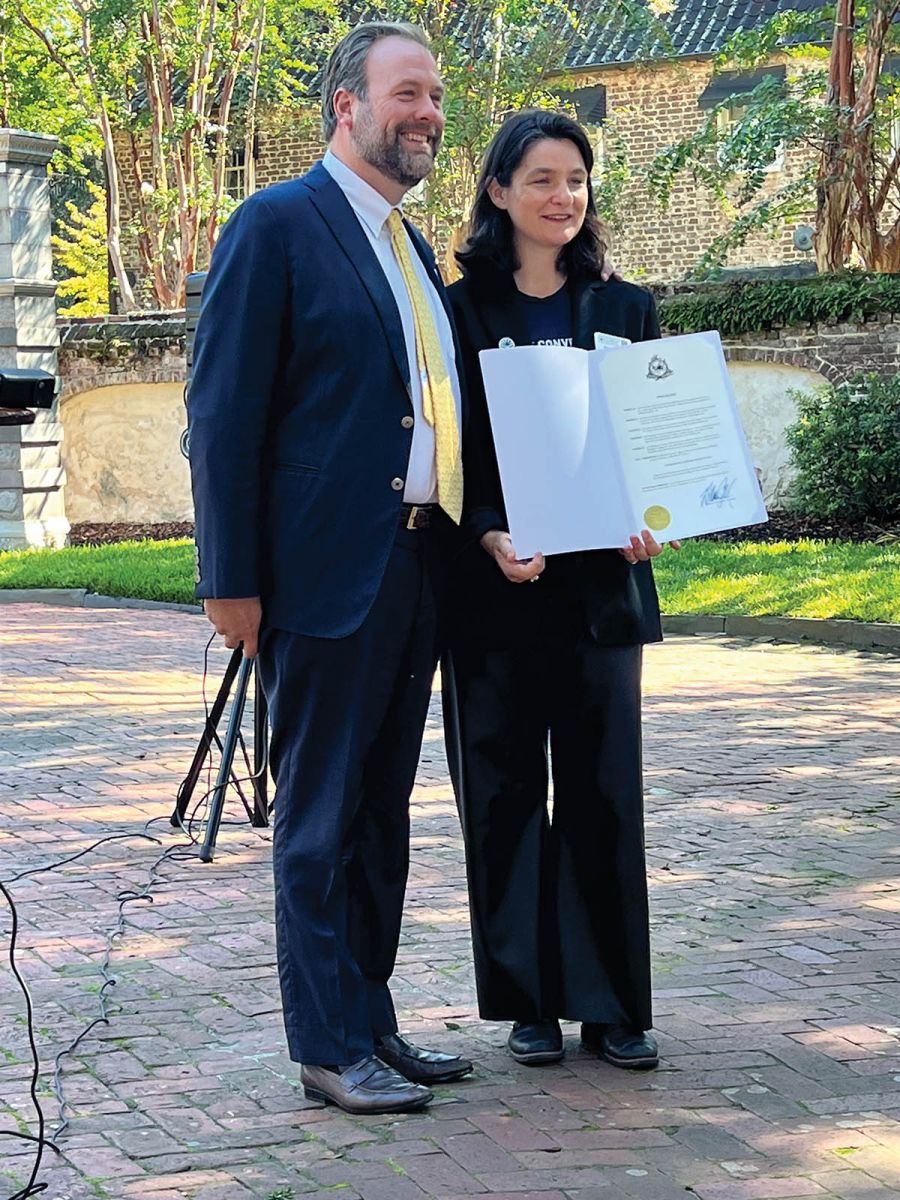
“Sarah was excited by and respected the origins of the festival and wanted to retain our dedication to excellence in literature and all that was positive about that. But she also brings the energy to make it new and contemporary. She has created a buzz that’s real and powerful,” says Reich. “I may be her mentor, but I’m also her student; I learn from her all the time. She has an innate sense of how to curate a festival with a unique identity that appeals to a wide audience.”
Right off the bat, Moriarty initiated the festival’s Young Writers Awards program and reenvisioned the Cato Fellowship Prize designed to “nurture and support emerging voices” to include an immersive residency during the 10-day festival. “It’s important to Sarah that the festival reach out more broadly to the community. We didn’t have the manpower to do that before, but she’s been able to move mountains,” says Pollak.
And with her unique European perspective, Moriarty continues to widen the festival’s lens. “We had an international genesis, but we’re expanding what that means to us,” she explains. “So it’s not just our British roots, but it’s Ireland, it’s France, it’s Germany, it’s Jamaica, it’s Ghana.” Similarly, Moriarty has broadened the festival programming with film and theater, including a 2024 world premiere of Patrick Bringley’s stage adaptation of All the Beauty in the World, and this year, a kid-friendly performance of Ulysses by Ireland’s Branar theater company. (No, you didn’t misread that.)
With Charleston as a backdrop and the Dock Street as “this space that hugs you, draws you in,” the festival has evolved to do more than celebrate big ideas, it hatches them. “Charleston is this amazing petri dish,” says Moriarty. “People meet, and next thing you know, Patrick Bringley is in conversation with Dominic Dromgoole, former artistic director of the Globe Theatre, and then they’re producing a play together, then suddenly it’s showing off-Broadway. Or Mena meets Adam Gopnik at a festival event, and they discover they’re both bonkers about an esoteric Philadelphia 76ers podcast, then suddenly they’re exploring a chamber opera collaboration, which then becomes a work-in-progress, and now it’s going to be a Spoleto show, but that’s all possible because of the magic of this place,” she says.
“We try to be global in our outlook but also incredibly local and intimate in its experience. You walk out of a program and then run into the author you just saw onstage having a glass of wine at Bin 152 and strike up a conversation. That happens over and over again; it’s pretty miraculous,” she adds. “But it happens because Charleston is a place where people love the arts, love culture. I feel very grateful to be a part of a community that shares my love of the literary arts.”

The festival’s parties, readings, author meet-and-greets, and performances await
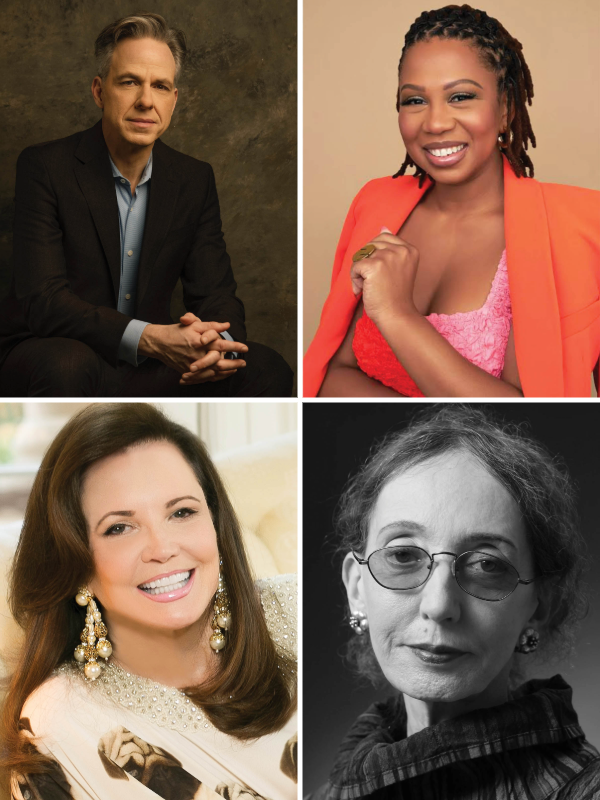
The 2025 Charleston Literary Festival presents more than 50 events featuring 70-plus world-renowned writers and thinkers who span the globe and literary genres, making it the biggest program in CLF’s nine-year history. Through conversation-based presentations that encourage dialogue, understanding, and imagination, the 10-day festival explores fiction, history, poetry, memoir, biography, and the craft of writing, as well as offers a film screening and two theatrical performances. The lineup includes CNN anchor and journalist Jake Tapper, Booker Prize contender Katie Kitamura, Southern Charm’s Patricia Altschul, literary giant Joyce Carol Oates, environmentalist Bill McKibben, and Pulitzer Prize winner Michael Cunningham, among many others.