
Learn Tiffany Reed Silverman is expanding the college's art initiatives beyond its gates
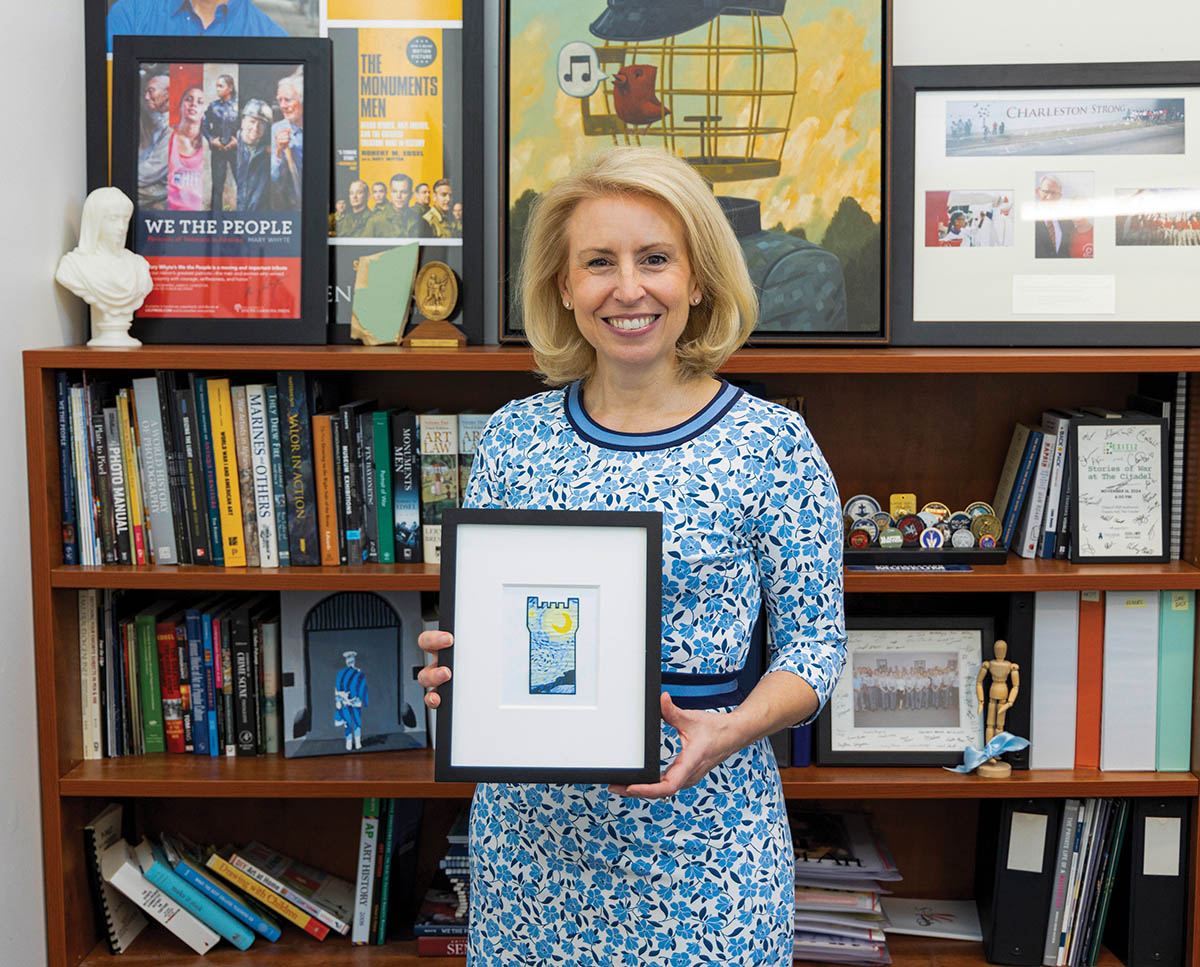
As The Citadel’s first director of fine arts, Beaufort native Tiffany Reed Silverman has revolutionized arts engagement within the institution over the past 12 years, guiding a fledgling program into one that earns national recognition. A former College of Charleston adjunct professor and director of education at the Gibbes Museum of Art, Silverman can be found teaching art history and appreciation or leading field trips to The Charleston Museum and Patriots Point.
Beyond the classroom, Silverman has championed high-profile public art initiatives, including tributes to the South Carolina National Guard and the Emmanuel 9, as well as collaborations with influential local artists like Mary Edna Fraser and Mary Whyte. In March, Silverman was named a Governor’s Award for the Arts recipient, recognizing her “outstanding achievement and contributions to the arts in South Carolina.” Here, she discusses the evolution of her engagement with the local arts community.
CM: What was your relationship with art growing up?
TS: Growing up in a military family, the emphasis was on service, not culture. It wasn’t until I took an art history class my first semester of college that I discovered how much art resonated with me. After the first day, I changed my major and never looked back. My husband and I met in graduate school for art history, and our three sons have grown up going to galleries and museums, so it’s been a different experience this time around.
CM: What led you to The Citadel?
TS: My plan was to be a curator, not a professor, much less one at a military college. A colleague at the Gibbes told me The Citadel was looking for someone to teach a fine arts appreciation class. The first time I set foot on campus felt like home. That was almost 18 years ago!
CM: How has the school’s arts program evolved since then?
TS: When we started, I was hanging art in a hallway, rinsing paintbrushes in a janitor’s closet, and holding concerts in a multipurpose room. Now, a quarter of the student body takes art classes, more than 17,000 people have visited the art gallery, and we’ve produced dozens of dance, music, and theater events. Capers Hall now includes an art gallery, performance auditorium, art studio, and digital media lab, which allow us to facilitate transformative experiences at the intersection of the arts, the military, and the community at a whole new level. We’re finally able to execute ideas that were a decade in the making and are eligible for national traveling exhibitions.
CM: What does a typical day look like?
TS: Every day is different. There’s a huge whiteboard in my office that lists all the programs and events within the semester, from combat artist residencies to the senior art showcase to exhibition design to board meetings, plus my teaching and advising schedule. I engage with people from every generation nearly every day and find that constant perspective shift to be invigorating.
CM: Are there any art initiatives happening off campus?
TS: After so much focus on launching our new art spaces, I am now able to expand beyond our gates. In March, I traveled with a group of cadets to Boston with the CofC Orchestra for their performance at Symphony Hall. Our first gallery exhibit, featuring work by combat artists about their Citadel experience, is currently on view at the Pritzker Military Museum outside Chicago. Most recently, I made some exciting new connections at the SC Arts Leadership Institute and plan to showcase more Citadel art soon in venues around the state.
CM: Tell us about some noteworthy art initiatives you’ve spearheaded.
TS: After the Emanuel 9 tragedy, words were not enough. With other Citadel partners, we turned a city block into a moment for the community to mourn, with 1,600 people each painting Gil Shuler’s iconic dove. Another meaningful project was working with Exit12 Dance Company, led by Marine combat artist Roman Baca. He collaborated with cadets to choreograph a dance that told the story of their lives, then they performed it together.
CM: How did you react to the Governor’s Award for the Arts nomination?
TS: I can’t help but think of Pat Conroy, the only other Citadel recipient of this award. Years ago, he told me how pleased he was to see the arts flourishing at his alma mater, and I hope this would also make him proud. I count myself lucky to be among such an esteemed group and will continue to build a lasting legacy for the arts at The Citadel and beyond.
Age: 52
Lives: James Island
Family: Husband, Josh, and sons, Jackson and twins Gabriel and Riley
Education: Art history degrees from College of William & Mary in Virginia and Williams College in Massachusetts; current MFA candidate at SCAD
Favorite local gallery: From the beginning, Robert Lange Studios has warmly invited cadets to experience art, both in the gallery at the favorite art walk and on campus.