

What fuels the creative impulse? The question is as old as the human spirit—and central to it. The quest for beauty, the desire to represent that essential wonderment that stirs the imagination, has propelled our species to draw on caves, erect pyramids, paint frescoes on chapel ceilings, and doodle in the margins of boring textbooks. The artistic impulse is universal, transcending all barriers established by social, racial, and geopolitical constructs, but sadly, precisely because of those barriers, not all artists get their due.
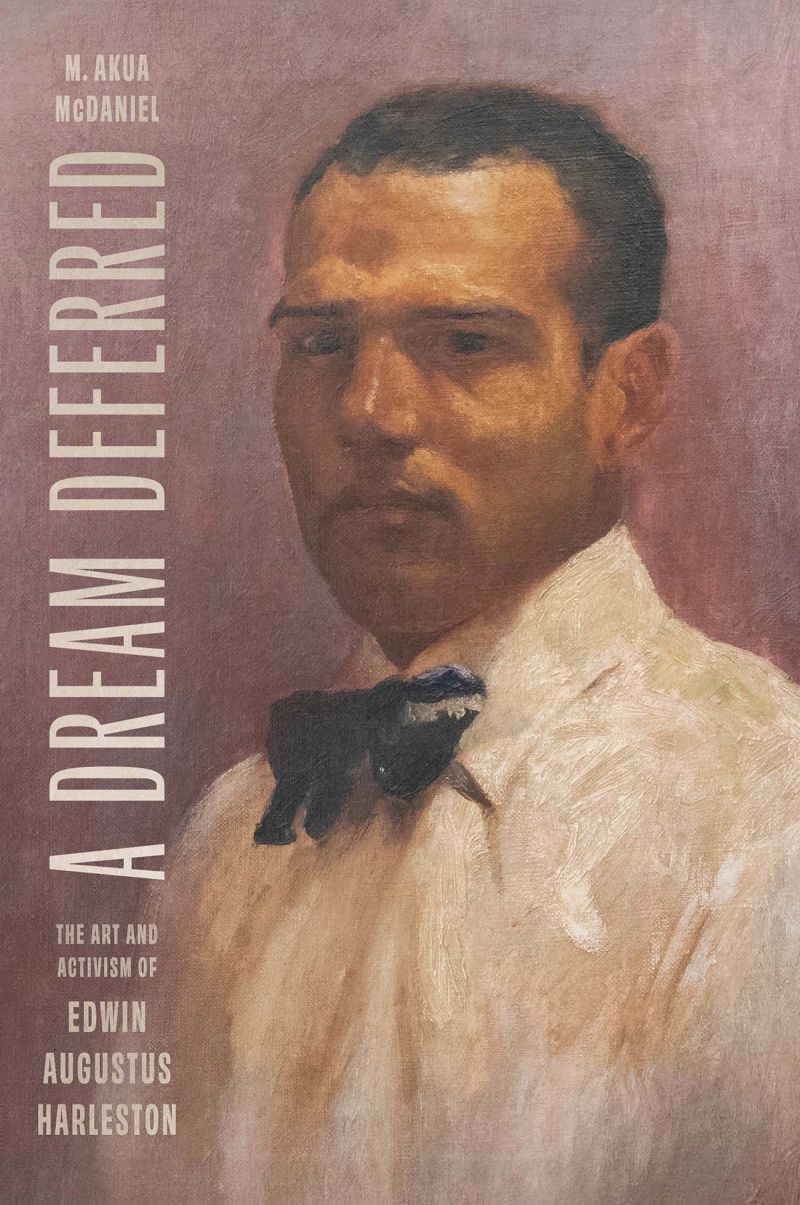
That was the case for Edwin Augustus Harleston, a Charleston-born African American artist of the early 1900s, who, despite his talent and classical training in the country’s most elite art institutions, never fully achieved the national recognition and acclaim he aspired to. Nor was he embraced by his local colleagues, artists such as Alice Ravenel Huger Smith and Elizabeth O’Neill Verner of the Charleston Renaissance, who were self-taught, and importantly, white. In A Dream Deferred (USC Press, 2026), art historian, professor, and founding director of the Spelman College Museum of Fine Art M. Akua McDaniel, sets the record straight. Her new biography offers a compelling portrait of Harleston’s artistic ambition and accomplishments and his many disappointments. Hers is an even telling: McDaniel brings expertise in evaluating artistic merit and describing the painterly qualities of Harleston’s work, while offering the broader context of the challenges of the time and place in which he was working.
Today, you can find six of Harleston’s portraits and paintings in the permanent collection of the Gibbes Museum of Art, but during his lifetime (1882–1931) that was not the case. He was denied an exhibition at The Charleston Museum after the Carolina Arts Association, of which Smith and Verner were leading members, convinced museum director Laura Bragg, who had teased Harleston with the opportunity for a solo show, to retract her invitation, saying it would be unbefitting for the South’s first museum to showcase the work of a Black artist. When he wished to paint landscapes at Magnolia Gardens, he had to sneak in disguised as a worker. To see his paintings, one had to visit Harleston Studios on Calhoun Street, adjacent to Emanuel AME Church and across the street from the family business, Harleston Funeral Services (where Delaney Oyster House now is), which he and his wife, Elise, a photographer, helped run. Funds were perpetually tight, and Harleston often had to bury his artistic impulses while tending to the funeral business, but managed to find ways to travel to New York City, Atlanta, and Chicago to try to drum up portrait commissions, with limited success.
As a graduate of Avery Normal Institute and Atlanta University who attended both the School of the Museum of Fine Arts Boston and the Chicago Art Institute—and as a member of Charleston’s Black elite (only three-tenths of one percent of the nation’s Black population were college graduates, McDaniel tells us)—Harleston was a man of keen intellect. And he was pulled in many directions. Harleston returned to Charleston from Boston reluctantly in 1912 and found the city “covered in a shroud of sadness,” writes McDaniel, as stately homes were in disrepair and the city’s economic boon in decline. He missed the vibrant Black culture he enjoyed in visits to Harlem and other Northeast urban hot spots, but he stepped up as a prominent member of Charleston’s Black middle class, becoming the first president of the Charleston NAACP chapter in 1917. He had studied under W.E.B. Du Bois, with whom he maintained a lifelong friendship, and while McDaniel gives us the facts of these aspects of Harleston’s life, including how he successfully lobbied for Charleston to finally allow Black teachers to work in “negro schools,” I longed for more insights into Harleston’s civil rights leadership and racial justice endeavors and how they may have impacted his creative life.
This biography gives us excellent broad brushstrokes of Harleston’s fascinating, frustrating, and sadly short life (he died at age 49). As a scholar, McDaniel writes with an academic bent, filling in important gaps in the art history record, for which we owe her a debt of gratitude. Yet I’m left feeling there is room for more storytelling, more hue and texture, about Harleston and the Charleston he lived in. “Shaped by the philosophies of W.E.B. Du Bois and other civil rights activists of the day, Harleston believed that portraits of his family, friends, and neighbors would be his way of bearing witness to the fact that African Americans were not the inferior beings whom society had unapologetically relegated to the rank of a second-class citizen,” she writes. By bearing witness to his bearing witness, she begins to paint the fuller picture.