


- Age: 57
- Hometown: Awendaw, SC
- Family: Son, Joseph
- Education: Howard University
- Another meaningful memorial: I visited the Korean War Memorial with my father, who fought in the war, and saw what it meant to him. The soldiers and landscaping are both beautiful and frightening as it tells the story of bravery and brotherhood.
Few events in Charleston’s history hold the weight of the massacre that took place on June 17, 2015. The racially motivated mass shooting at the Mother Emanuel AME Church took the lives of nine African American parishioners attending Bible study at the historic Black church. More than a decade later, the impact of the tragedy continues to be felt throughout the city.
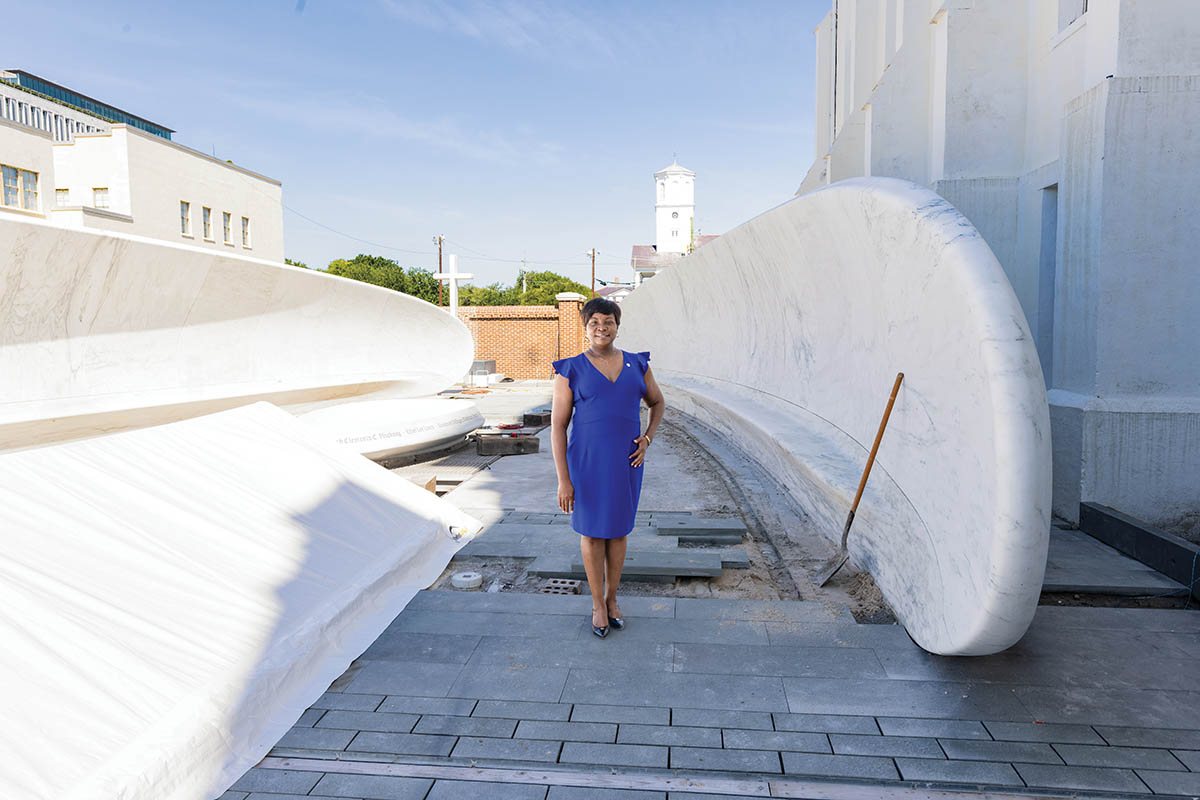
On November 14, the Mother Emanuel Memorial Foundation (opens in a new tab), led by executive director Deona Smith, will open the long-awaited Emanuel Nine Memorial. Designed by architect Michael Arad, who also created New York City’s 9/11 Memorial, the site features a courtyard anchored by two monumental marble benches and a fountain inscribed with the names of the Nine. A second phase, the Survivors’ Garden, is expected to be completed by the end of 2028. Here, Smith shares the story behind the memorial, the meaning embedded in its design, and what’s needed from the community to bring its next phase to fruition.
CM: What led you to your position at the Mother Emanuel Memorial Foundation?
DS: I founded my own nonprofit, Sister Summit, in 2011, working with women of color to give them professional and personal development skills. Three years ago, I got a call saying that the Mother Emanuel Memorial Foundation needed help with fundraising, and over time I built really great relationships with the board and team. In 2025, I was asked about my interest in taking the executive role. Working on this project falls in line with what I’m passionate about, which is the uplifting of my community.
CM: Tell us about the different sections of the memorial.
DS: The Memorial Courtyard consists of the fellowship benches, the Cross of Hope, and the Fountain of Grace, which has the names of the Nine inscribed on it. To the rear of that will sit a space offering more quiet reflection, where someone can step away from the crowd and sit with themselves. Phase two, which will hopefully wrap by the end of 2028, will be the Survivors’ Garden, which includes five trees, one for each of the survivors, and six benches. When you take the path around the back of the church toward the garden, it’s a literal journey from the tragedy that took place to a space of triumph and joy, dedicated to those who experienced this horrific act of violence.
CM: What inspired the decision to hire Michael Arad?
DS: In addition to requesting a typical proposal, the board asked potential designers to write an essay about forgiveness, a theme strongly related to the memorial because of the response of family members. Michael involved himself at a whole different level by having conversations with the families. The fellowship benches he designed were constructed from massive marble blocks that fit together and seem to lean on each other for support, like the community did following the tragedy. Some people look at them and see an angel’s wings from the way they curve.
CM: What do you hope visitors take away from the experience?
DS: The whole idea of this memorial is to remember and prevent this from ever happening again. We want to move forward in a community free of hatred, racism, and division, where we respect one another’s humanity and differences. When I think about the Emanuel Nine, they all dedicated their lives to service in one way or another, whether as clergy, teachers, librarians, or politicians. We all have a duty to be the best people we can be.
CM: Tell us about the dedication ceremony.
DS: We will have a free public opening where we invite everyone to come see the space and how we’ve honored our very precious community members. I want to see Calhoun Street flooded with people that day. There will be speeches from the board and elected officials, and performances from gospel choirs, Charlton Singleton’s jazz quartet, and dancers. Post-opening, the memorial will be open to the public daily for free, with opportunities for paid tours that take a deeper dive into the history of the church and the memorial’s construction and architectural story.
CM: What comes next—and how can the community help?
DS: We’re still fundraising for the Survivors’ Garden and to establish an endowment to maintain the space for generations to come. We plan to provide educational programming, including film screenings and lectures discussing themes like forgiveness, reconciliation, and what it means to acknowledge our own biases.
CM: What has taking stewardship of this project meant to you?
DS: I grew up in the AME church, so this memorial isn’t just a professional undertaking; it’s connected to my own faith and upbringing. Being entrusted with honoring the lives of the Emanuel Nine and doing so in a way that reflects the dignity and strength of their families and this community is one of the greatest honors of my career. I feel a responsibility to get this right and to ensure that we always remember what happened on June 17, 2015.